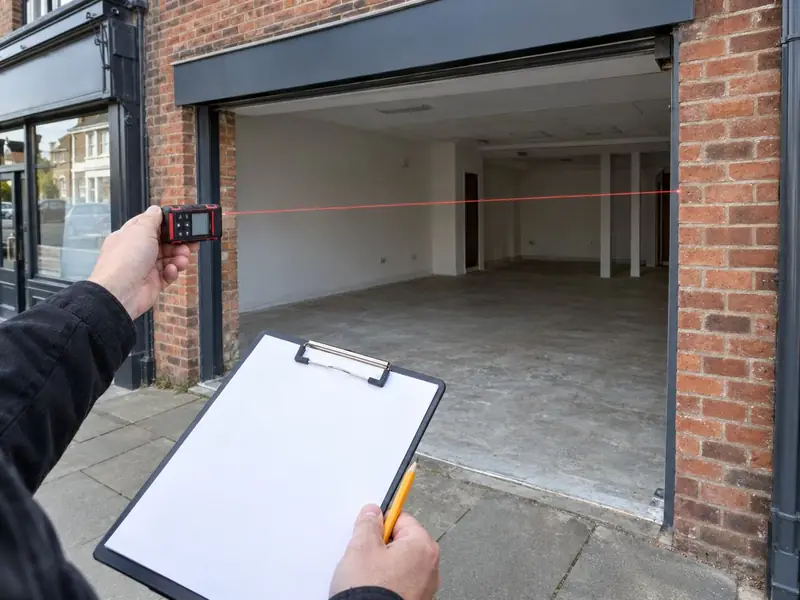
Why measure before the survey?
Your own measurements are useful for an early guide price and for checking whether an idea is realistic, such as fitting the box behind the fascia or fitting an internal shutter. They also make the survey conversation more productive.
They are not for ordering. Shop shutters are made to measure, and the final sizes are taken at the free survey, where we also check the structure, the fixings and the power supply. Use the steps below to get as close as you can.
What will I need?
- a steel tape measure that reads in millimetres;
- a spirit level, ideally a long one;
- a stepladder in good condition, used on firm level ground;
- a phone to take photos;
- a notepad, or a sketch of the shopfront to write on;
- a helper, both for holding the tape and for footing the ladder.
Measure outside trading hours if the pavement is busy, and do not lean out from a ladder or climb onto fascias, canopies or signs.
How do I measure the width?
Measure the clear width of the opening between the reveals, meaning the inside faces of the brickwork, stone or pilasters on each side. Take three readings, at the top, middle and bottom, because openings are rarely perfectly square. Record all three and note the smallest.
If the shutter will be fitted to the face of the building rather than inside the reveals, the guides will sit outside the opening, so also measure how much flat wall there is on each side, and look for downpipes, signs or a neighbour's doorway that could get in the way.
On a wide frontage, also measure any piers or mullions between the door and the windows. Very wide openings are sometimes split into two shutters with a fixed or removable centre post, and knowing where the natural divisions fall helps us suggest the best layout.
How do I measure the height?
Measure from the ground to the underside of the fascia, lintel or head of the opening at the left side, the middle and the right side. High streets often slope, so the readings may differ noticeably from one side to the other. Note any step, threshold strip or drainage channel where the bottom rail will land, and whether the ground is paving, tarmac or a timber stallriser.
A level placed across the opening at the bottom will show which way, and by roughly how much, the ground falls.
How much headroom does the box need?
The curtain coils around a barrel inside a box above the opening. The taller the shutter, the bigger the coil and the box. As a rough guide, shop shutter boxes are often somewhere between 205 mm and 300 mm deep and high, depending on the shutter's height and lath type, but the exact size depends on the product.
Measure the space from the top of the opening to the underside of any projecting fascia, canopy or soffit, and the depth available behind the fascia if you would like the box hidden. If there is not enough room, the box may sit below the head of the opening, reducing the clear height. Our guide to box and fascia options explains the choices.
How much side room do the guides need?
Guides typically need around 75 mm to 100 mm on each side, depending on the shutter and whether the guides are fitted within the reveals or on the face of the wall. Heavier, wider or security-rated shutters may need deeper guides.
The wall or frame each guide fixes to must be sound. Note whether it is brick, block, stone, concrete, steel or timber, and whether it is covered in render or cladding that might hide something weaker. Cracked brickwork, crumbling mortar or old fixing holes close to the edge of the opening are worth photographing, because they can affect where the guides go and whether a steel subframe is needed.
What should I write down?
| Measurement | Where to take it | Why it matters |
|---|---|---|
| Width | Top, middle and bottom, between reveals | Sets curtain width and guide position |
| Height | Left, middle and right, ground to underside of head | Sets curtain height and box size |
| Headroom | Head of opening to fascia, canopy or soffit | Shows whether the box fits above |
| Side room | Each side of the opening | Room and fixings for guides |
| Reveal depth | Front face of wall to the glazing frame | Whether the shutter fits within the reveals |
| Ground fall | Across the threshold | Bottom rail seal and locking |
| Power | Nearest socket, spur or distribution board | Cost of supplying an electric shutter |
What else should I look out for?
- Doors opening outwards, which would clash with an external curtain, or inward-opening doors that would clash with an internal one.
- Fire escape routes. If the shopfront door is also an escape route, tell us, because the shutter must not obstruct escape while people are inside.
- Fittings on the facade, such as lights, CCTV cameras, alarm boxes, hanging signs, awnings and blind boxes.
- Internal obstructions, such as suspended ceilings, sprinklers, alarm sensors and display units, if you are considering an internal shutter.
- Services, such as gas meters, drainage and cables near the opening.
Take photos of the whole frontage, both sides of the opening and the area above the fascia.
What happens at the free survey?
For new shutters, the survey is free. We re-measure everything precisely, check the structure and fixing points, look at the power supply route, and talk through the lath type, box position, colour and controls. You then receive a written quotation. If a hidden box is the aim, we check the fascia depth and construction for a concealed fascia shutter.
It helps to have your own measurements and photos to hand, together with anything you already know about planning, your lease or your insurer's requirements. If the shopfront itself is old, damaged or due to be replaced, mention it, because fitting a new aluminium shopfront and shutter together can be simpler than adapting a shutter to a frontage that will not last.
Questions about this guide
Should I measure in millimetres or inches?
Millimetres. Shutter manufacturers work in millimetres, and the small differences matter when a curtain has to run smoothly in its guides. Write each figure next to where you took it, for example 'width, top: 2,985 mm', so there is no confusion later.
My opening is not square. Is that a problem?
Not usually. Very few shop openings are perfectly square or level, which is why you take three widths and three heights. Guides are set plumb and packed out where needed, and the bottom rail can often be adjusted to suit a sloping threshold. We check this at the survey.
Can I order a shutter using my own measurements?
We do not recommend it. Shutters are made to measure, and a small error in width, height or headroom can mean a curtain that binds in its guides or a box that does not fit. We take final measurements at the free survey and confirm the price in writing before anything is ordered.
What if there is no room above the opening for the box?
There are several options. The box can sit just below the head of the opening, reducing the clear height slightly, the shutter can be fitted inside the shop, or the box can be hidden behind a deeper fascia with some alterations. Each affects cost and appearance differently, and we explain which suits your shopfront at the survey.
Sources
- Safe use of ladders and stepladders (HSE)
- BS EN 13241: Industrial, commercial and garage doors and gates product standard (BSI)
This guide is general information, not legal advice. Your local planning authority, landlord and insurer have the final say on your premises.