What is the difference between internal and external shutters?
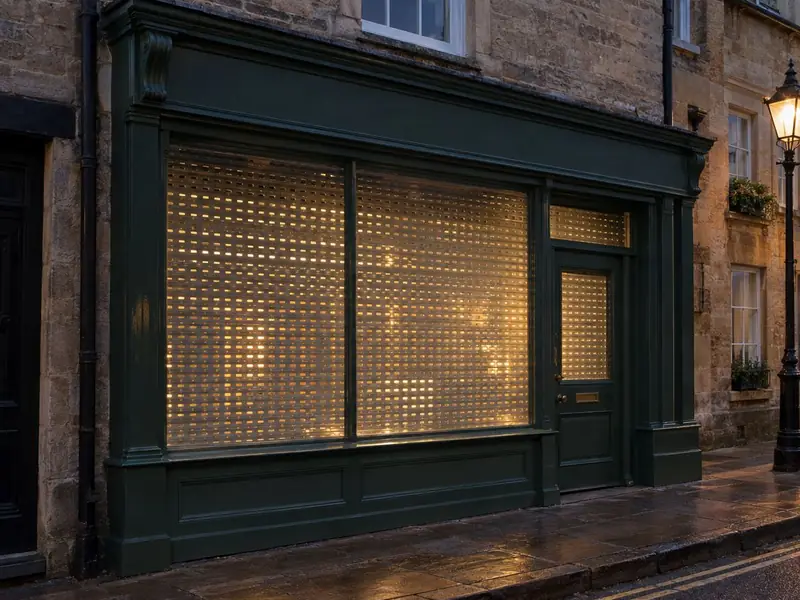
An external shutter is fitted on the outside of the shopfront. The box sits on or behind the fascia, the guides run down the face of the building or into the reveals, and the curtain closes over the glass and doors.
An internal shutter is fitted inside the shop, behind the glazing. The box is fixed to the ceiling, a bulkhead or a steel frame, and the guides run down to the floor just inside the window line. From outside, the shopfront looks unchanged, and when the shutter is down people see it through the glass.
Both are usually roller shutters, and many of the same curtain types are available either way, including solid, perforated, punched-lath and open-grille designs.
How do internal and external shutters compare?
| Factor | External | Internal |
|---|---|---|
| Protects the glass | Yes | No |
| Planning permission | Usually needed | Usually not, unless listed or controlled by a condition |
| Effect on the shopfront | Box, guides and curtain visible | Little or none from outside |
| Weather exposure | Rain, frost, salt and grime | Sheltered |
| Space inside the shop | No floor or window depth lost | Takes depth behind the window |
| Graffiti and fly-posting | Exposed | Behind the glass |
| Guide price (ex VAT) | Electric solid £1,495–£2,695 | £1,395–£2,595 |
Does an internal shutter protect the glass?
No, and this is the main trade-off. An internal shutter stops an intruder getting past the window line and into the shop, and it keeps stock out of reach, but it does nothing to stop the glass being smashed. After an attack you may still face emergency boarding, a glazing bill and a closed shop while the glass is replaced.
Many retailers who choose internal shutters pair them with laminated glass, which tends to hold together when struck and makes a quick grab through a broken pane harder. A glazier can advise on the right specification for your shopfront.
When is an external shutter the better choice?
- The glass is a target, for example on a street with a history of smashed windows or vandalism.
- Your insurer requires it. Some policies specify an external shutter, or a certified product that is only available in an external configuration.
- There is no space inside because displays, counters or fridges sit tight against the glass.
- The entrance is recessed, and closing the shutter at the front line stops the lobby collecting litter or being used as cover.
- Planning is likely to be granted, for example on a parade where approved external shutters are already the norm.
When is an internal shutter the better choice?
- Conservation areas and historic shopfronts, where external shutters are often refused. Remember that a listed building may still need listed building consent for internal works.
- Shopping centres and arcades, where the landlord's fit-out rules may require shutters at the unit front, behind the glass line or within the shop.
- Shops that want a clean frontage, with no box, guides or curtain visible by day.
- Exposed coastal or roadside sites, where an internal shutter avoids salt spray and traffic grime and may need less cleaning.
An open-grille shutter fitted internally keeps the display visible through the glass while still closing off the shop floor. Our internal shop shutters page covers the options.
How much space does an internal shutter need?
Plan for three things: room for the box at the top, room for the guides at the sides, and a clear zone between the glass and the curtain.
- Headroom. The box is fixed at ceiling level, so a suspended ceiling, sprinkler heads, lighting tracks, alarm sensors or air conditioning may need adjusting. Suspended ceilings are not strong enough for fixings, so the box needs a structural support above or a freestanding frame.
- Side room. Guides need a solid fixing to walls, columns or posts on each side of the opening.
- Depth. The curtain comes down behind the window display, so the display area is effectively between the glass and the shutter. Doors that open inwards must clear the curtain line.
We check these points at the free survey. See our measuring guide if you want to take rough sizes first.
Will an internal shutter avoid planning permission?
Usually, because a shutter behind the glass does not materially change the outside of the building. There are exceptions. Listed buildings need listed building consent for works affecting their character, inside as well as out. Some units have planning conditions controlling the shopfront. In shopping centres, the landlord's consent is needed whatever the planning position. Our planning guide explains the rules for external shutters in each UK nation.
Can I combine internal and external protection?
Yes, and many shops do. Common combinations include:
- an external shutter over the entrance door, where the planning impact is smaller, with internal shutters behind the display windows;
- an external shutter on the main frontage and a counter shutter inside to secure a till point, kiosk or high-value cabinet;
- laminated glass on the frontage with an internal grille behind it, where external shutters are not allowed.
Layering means an intruder has to defeat more than one barrier, and it lets you put the strongest protection where the stock is most valuable. It can also help where the council will accept an external shutter on one part of the frontage but not another.
Does an internal shutter need different maintenance?
The mechanics are the same, but internal shutters are sheltered from rain, frost and road salt, so corrosion is usually less of an issue. The common problems are different: stock, display stands or cleaning equipment left in the curtain's path, and dust building up in the guides. Keep a clear line under the shutter and make sure staff know not to store anything there. Electric internal shutters need the same safety devices and annual servicing as external ones.
External shutters face the weather, so the checks lean towards corrosion on the bottom rail and guides, grit and leaves in the channels, frost holding the curtain to the ground and wear on outdoor key switches. On either type, a technician should look at the fixings, as these loosen over time with vibration.
Questions about this guide
Is an internal shutter less secure than an external one?
It protects in a different way. An external shutter keeps intruders away from the glass, while an internal shutter lets them break the glass but stops them getting further. For grab-and-run theft from a window display, an internal shutter set close to the glass can be effective. For vandalism or glass damage, an external shutter offers more protection.
Can an internal shutter be electric?
Yes. Internal shutters can be manual or electric, and electric operation is common because the controls can sit inside the shop. You will need a suitable fused supply near the box, and the same safety devices apply as on an external electric shutter. A key switch or remote is usually placed so staff can see the curtain while it moves.
Will an internal shutter hide my window display?
Only if you choose a solid curtain. The window display normally sits between the glass and the shutter, so it stays visible from the street whatever curtain you choose. If you want customers to see deeper into the shop after hours, an open-grille or punched-lath internal shutter keeps the sales floor visible as well.
Do shopping centre landlords allow external shutters?
It depends on the centre. Many enclosed centres control shutters through their fit-out guide, often specifying grilles or shutters at the unit front in an approved style and colour. Get the landlord's written approval of the design before ordering, and check whether the centre's fire strategy affects where the shutter can go.
Sources
- When is permission required? (GOV.UK planning guidance)
- Historic environment (GOV.UK planning guidance)
This guide is general information, not legal advice. Your local planning authority, landlord and insurer have the final say on your premises.