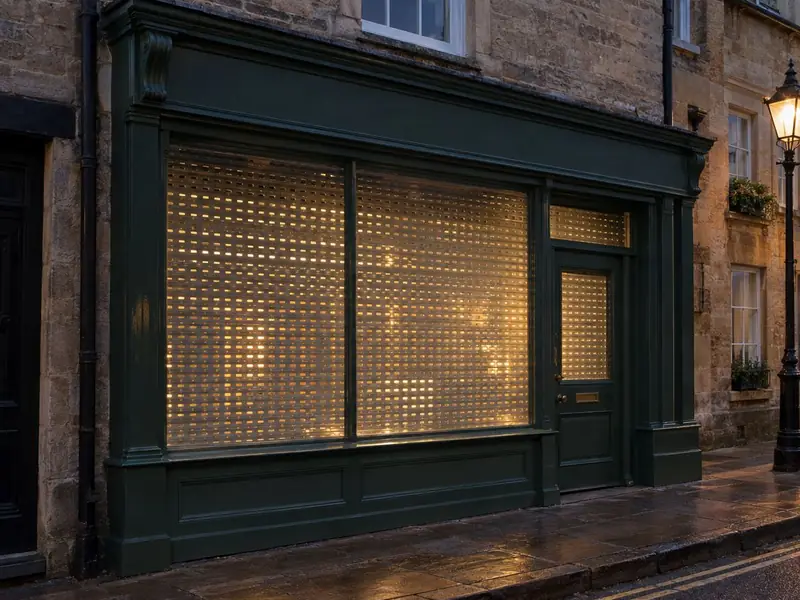
What is different about a conservation area?
A conservation area is an area of special architectural or historic interest whose character the council aims to preserve or enhance. When it decides a planning application in a conservation area, the council must pay special attention to that character, so the bar for an external shutter is higher than on an ordinary street.
In practice, officers look closely at how a shutter affects the street after hours. A row of solid shutters can make a historic high street feel closed and lifeless at night, which is why many conservation area appraisals and shopfront guides list solid external shutters among the changes they want to avoid.
Some conservation areas are also covered by directions that remove certain permitted development rights. Shutters already need permission, but a direction can bring related works, such as replacing upper-floor windows or doors, under control too.
When do I need listed building consent?
Listed building consent is needed for works that affect the character of a listed building as a building of special architectural or historic interest. That covers the inside as well as the outside, and it applies whatever the grade or category of listing. For a shop, it can include:
- fixing an external box or guides to a historic fascia, pilasters or stonework;
- cutting into a cornice or console brackets to hide a box;
- fixing an internal shutter to historic window frames, panelling or ceilings;
- removing or altering an original shopfront to fit a new shopfront and shutter.
Listed building consent is separate from planning permission, and you may need both. Carrying out works to a listed building without the consent they need can be a criminal offence as well as leading to enforcement, so this is not a step to skip.
Which shutter designs are usually accepted?
No design is accepted automatically, but some approaches tend to sit better with conservation officers than others:
| Approach | Why it is often favoured | Points to check |
|---|---|---|
| Internal shutter behind the glass | Leaves the historic shopfront untouched and visible | Fixings into historic interiors; space behind displays |
| Open-grille roller shutter | Keeps the window display and lighting visible | Glass is still exposed to damage |
| Punched-lath vision shutter | Good visibility with a more solid curtain | Higher cost; the box still needs hiding |
| Retractable grille | Can be stored out of sight during the day | Suits doorways and smaller openings best |
| Laminated security glazing | No shutter at all | Ask a glazier about the level of protection |
Whichever you choose, the box position and colour matter as much as the curtain. See our guide to box and fascia options.
How can the box and guides be hidden on a historic shopfront?
The box is usually the hardest part to get right. Options include fitting it behind an existing deep fascia, inside the shop above the transom, or within a new fascia that follows the historic profile. Projecting boxes fixed to the face of the building are the option most often refused.
Guide rails can sometimes be set into the reveals or tucked behind pilasters so that they are barely noticeable when the shutter is open. Where pilasters, corbels or console brackets survive, fixings should avoid cutting through them, and fixing into sound mortar joints rather than stone faces can make future removal less damaging.
Our concealed fascia shutters keep the box out of sight; any fascia alterations are quoted separately.
What colour should a shutter be in a conservation area?
Bare galvanised steel rarely suits a historic street. Councils usually expect a powder-coated finish in a colour that matches or complements the shopfront joinery, often a dark, muted tone. Some design guides name preferred colours; others simply ask that the shutter, box and guides read as part of the shopfront rather than as an addition.
The box, guides and bottom rail should normally be finished in the same colour as the curtain, so that nothing stands out in bare metal when the shutter is open. Where the shopfront itself is being repainted, agree the shutter colour at the same time so the two match.
Ask for a physical colour sample before the council decides, because RAL colours look different on screen. Our colour guide covers finishes and costs.
What should I send with the application?
Alongside the usual drawings, councils normally want a heritage statement explaining what is significant about the building or area and how the proposal affects it. For a shutter, that usually means:
- photographs of the shopfront and its neighbours, by day and, if possible, at night;
- details of historic features such as the fascia, cornice, pilasters and stallriser;
- a section drawing showing the box, guides and fixings;
- the lath type, perforation pattern and colour;
- why the security measure is needed, for example a history of break-ins or an insurer's requirement.
A clear explanation of need helps officers weigh security against appearance. If your insurer has asked for a shutter, include their letter. Crime figures for the street, or a note from the local policing team, can also help show that the request is proportionate.
It also helps to show that you have considered less intrusive options first, such as an internal shutter or laminated glass, and to explain why they would not work for your shop. Officers are more likely to support an external shutter when the application shows the design has been chosen with the building in mind rather than taken straight from a catalogue.
What if the council refuses an external shutter?
A refusal is not always the end of the matter. Read the reasons carefully: they often point towards an acceptable alternative, such as an internal shutter, a grille or a different box position. You can submit a revised application, and there is a right of appeal, although an appeal takes time.
In the meantime, think about other layers of security: better locks, internal grilles over high-value displays, alarms and lighting. Our guide to internal or external shutters explains what an internal system can and cannot protect.
Can I keep an old shutter that was fitted years ago?
If a shutter was fitted with the necessary consents, it can normally stay. If it was fitted without them, the position is less certain, especially on a listed building, where enforcement is not subject to the same time limits as ordinary planning breaches. If you are buying or leasing a historic unit with an existing shutter, ask for copies of the consents. When the time comes to replace it, the council may expect a design that better suits the area.
How the rules differ across the UK
England
Conservation areas are designated by councils, and buildings are listed by the Secretary of State on the advice of Historic England, in grades I, II* and II. Applications for planning permission and listed building consent go to the local planning authority, which consults Historic England on some proposals affecting higher-grade buildings.
Wales
Buildings are listed by the Welsh Government through Cadw, in grades I, II* and II, and conservation areas are designated by local planning authorities. Listed building consent is decided by the local planning authority under the Historic Environment (Wales) Act 2023, in force since 4 November 2024. Cadw publishes guidance on managing change to listed buildings and conservation areas.
Scotland
Buildings are listed by Historic Environment Scotland in categories A, B and C. Listed building consent and conservation area consent are dealt with under the Planning (Listed Buildings and Conservation Areas) (Scotland) Act 1997, with applications made to the planning authority. Historic Environment Scotland's Managing Change guidance notes are widely used when assessing alterations to historic shopfronts.
Northern Ireland
Buildings are listed by the Department for Communities, in grades A, B+, B1 and B2, and its Historic Environment Division advises councils on applications affecting listed buildings. Conservation areas are designated by councils. Applications for planning permission and listed building consent are made to the council under the Planning Act (Northern Ireland) 2011.
Questions about this guide
Is a roller grille more likely to be accepted than a solid shutter?
Often, yes. Open grilles and punched-lath shutters keep the window visible, which matches what most conservation guidance asks for. Acceptance still depends on the box position, fixings, colour and the character of the street, so a grille with a projecting box on a sensitive building may be refused while a well-hidden internal shutter is accepted.
Do I need consent for an internal shutter in a listed building?
Very possibly. Listed building consent covers works affecting the building's character inside as well as out, so fixing a box to a historic ceiling or guides to original window frames may need consent. A freestanding internal frame that avoids historic fabric is less likely to, but the council's conservation officer should confirm the position in writing.
How do I find out if my shop is in a conservation area?
Your council publishes maps of its conservation areas, usually on its planning web pages, and many publish appraisals describing each area's character. Listed buildings can be checked on the official heritage list for England, Wales, Scotland or Northern Ireland. If in doubt, ask the planning department before you commission drawings.
Can you survey a listed shopfront before I apply?
Yes. For new shutters our survey is free. We record the opening, fascia depth, reveals and fixing points, note historic features, and suggest shutter types and box positions likely to suit conservation guidance. The decision rests with the council, so we suggest sharing our specification with the conservation officer at pre-application stage.
Sources
- Historic environment (GOV.UK planning guidance)
- Planning (Listed Buildings and Conservation Areas) Act 1990
- Listed buildings (Cadw)
- Planning and guidance (Historic Environment Scotland)
- Listed buildings (Department for Communities, Northern Ireland)
This guide is general information, not legal advice. Your local planning authority, landlord and insurer have the final say on your premises.