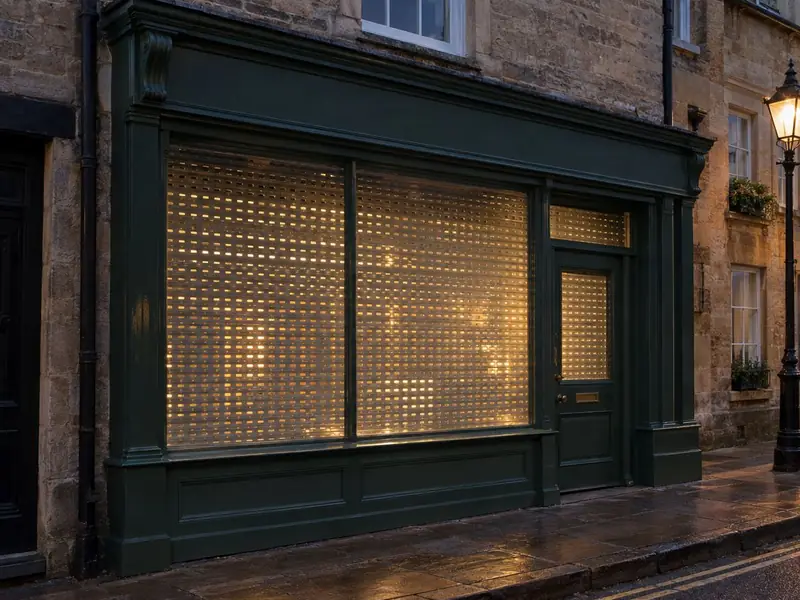
Why does an external shop shutter need planning permission?
Planning law controls 'development', and that includes building works that materially affect the external appearance of a building. An external roller shutter adds a box, guide rails and a curtain that covers the shopfront whenever the shop is shut, so councils generally treat it as development that needs planning permission.
There is no permitted development right that covers external shop shutters, unlike some minor works to houses. The starting point for any new external shutter, or for an external shutter that replaces one of a different design, is therefore a planning application to your local planning authority.
The same principle applies in England, Wales, Scotland and Northern Ireland, although the legislation, forms and heritage bodies differ. The nation notes on this page summarise the main differences.
Do internal shutters need planning permission?
A shutter fitted behind the glass usually does not need planning permission, because it does not materially change the outside of the building. From the street the shopfront still reads as glazing, and at night passers-by see the shutter through the window rather than a box and guides on the facade.
There are two important exceptions:
- Listed buildings. Works that affect the character of a listed building need listed building consent, inside or out, so an internal shutter fixed to historic fabric may still need consent.
- Planning conditions. Some shop units, particularly in newer developments, carry conditions controlling the shopfront. Check the original permission before assuming internal works are free of control.
Our internal shop shutters page explains how the box and guides are fitted inside the unit.
What do councils look for in a shop shutter application?
Councils judge shutters against local plan policies and, in many areas, a published shopfront design guide. Wording varies, but the same themes come up repeatedly:
- Visibility. Perforated, punched-lath and open-grille designs are generally preferred to solid steel, because they let light and a view of the window display through after hours and avoid a 'dead' frontage.
- Hidden boxes. Councils often ask for the box to sit behind the fascia or inside the shop rather than projecting from the front of the building.
- Guide rails. Guides recessed into the reveals or pilasters are usually favoured over guides fixed to the face of the building.
- Colour. A powder-coated finish that suits the shopfront tends to be preferred to bare galvanised steel.
- Character of the street. In conservation areas and historic parades, solid external shutters are often resisted.
Solid shutters are not ruled out everywhere, but expect more questions if you propose one on a busy high street. Our guide to perforated or solid shutters sets out the practical trade-offs.
What should a planning application include?
Requirements vary between councils, so check the local validation checklist before you submit. A typical application for a shop shutter includes:
- the application form and the council's fee;
- a location plan and a site plan;
- existing and proposed front elevations, showing the shopfront with the shutter down;
- a section drawing showing where the box and guides sit relative to the fascia;
- the product type, lath style, finish and RAL colour;
- a design and access statement where required, and a heritage statement if the building is listed or in a conservation area.
Planning applications are made by the owner or occupier, or by an agent acting for them. For new shutters, we provide the product specification, dimensions, colour and box position from our free survey, which you or your architect can use in the drawings.
How long does a planning decision take?
In England, the statutory period for deciding most minor applications is eight weeks from validation. Wales, Scotland and Northern Ireland set their own periods, so check the timescale your council works to. Some decisions take longer, particularly where a listed building or conservation area is involved, or where the council asks for amended drawings.
Build the decision period into your plans. If you are fitting out a new unit, apply for the shutter at the same time as any shopfront or signage changes so that one set of drawings covers everything. We can survey and quote before the decision and agree an installation date once permission is granted.
Can I get advice from the council before I apply?
Yes. Many councils offer pre-application advice, usually for a fee, in which a planning officer comments on a proposal before it is submitted. For a shutter this is worth considering if the building is listed, sits in a conservation area, or you want a solid shutter in a street where the design guide prefers visibility.
Bring photographs of the shopfront and a short description of the shutter type, box position and colour, and ask the officer which lath style and box position they would support. The answer often decides between an external perforated shutter, a concealed box or an internal shutter.
Does a sign or graphic on a shutter need consent?
Possibly. Printed logos, opening hours or images on a shutter can count as an advertisement, and adverts are controlled under the advertisement consent rules, separately from planning permission. Some small signs benefit from deemed consent; others need express consent from the council.
Artwork with no commercial message is less clear cut, so ask the council before commissioning it. If you change the fascia sign at the same time as fitting a concealed shutter, the new sign may also need advertisement consent, particularly if it is illuminated.
What happens if a shutter is fitted without permission?
Fitting an external shutter without the permission it needs is a breach of planning control. The council can invite a retrospective application and, if it would not grant permission, can take enforcement action that may require the shutter to be altered or removed.
Councils are expected to act proportionately, and many breaches are resolved informally. Even so, an unauthorised shutter can surface when you sell, re-let or refinance, because buyers' solicitors and landlords often ask for evidence of consent. Getting permission first is usually far cheaper than paying for a shutter twice.
Do I need permission to replace an existing shutter?
It depends on what changes. If the existing shutter had permission and the new one looks the same, with the same lath type, colour and box position, the council may not need a new application. If you are swapping a solid shutter for a perforated one, moving the box or changing the colour, ask the council first. Our replacement shutters service starts with a survey of what is there now.
How the rules differ across the UK
England
Planning permission is decided by your local planning authority: the district, borough, unitary or London borough council, or a national park authority. National policy expects good design and the conservation of heritage assets, and many councils add their own shopfront design guide. Listed building consent is a separate application, and Historic England is consulted on some proposals affecting the most significant buildings.
Wales
Applications go to the local planning authority: the county or county borough council, or the national park authority. Planning policy is set by the Welsh Government. Listed buildings and conservation areas are governed by the Historic Environment (Wales) Act 2023, in force since 4 November 2024, which replaced the 1990 Act in Wales. Cadw is the Welsh Government's historic environment service.
Scotland
Planning permission is required from the planning authority, usually the council, under the Town and Country Planning (Scotland) Act 1997. Listed buildings and conservation areas are covered by the Planning (Listed Buildings and Conservation Areas) (Scotland) Act 1997. Historic Environment Scotland publishes Managing Change guidance that councils use when judging changes to historic shopfronts.
Northern Ireland
Since 2015 the 11 councils have handled most planning applications under the Planning Act (Northern Ireland) 2011, with the Department for Infrastructure dealing with a small number of regionally significant cases. Listed buildings are designated by the Department for Communities, whose Historic Environment Division advises councils on proposals affecting them. Check your council's local development plan for shopfront policies.
Questions about this guide
Does my landlord's consent replace planning permission?
No. A landlord's consent under your lease is a private agreement and does not grant planning permission, and planning permission does not replace the landlord's consent. For most leased shop units you need both before an external shutter goes up. Ask your landlord early, because some leases also control colours, signage and fixings to the facade.
Does a perforated shutter avoid the need for planning permission?
No. A perforated external shutter still changes the appearance of the building, so it normally needs planning permission in the same way as a solid one. The difference is that councils are often more willing to approve perforated, punched-lath or open-grille designs, because they keep the shopfront visible after closing time.
Is planning permission needed for a shutter on the back of a shop?
Often, yes, because a shutter on a rear or side elevation is still an external alteration. Councils may take a more relaxed view of a solid shutter on a service yard than on the main street frontage, but that is a judgement for the planning authority. Check before ordering, especially if the rear faces a road or a conservation area.
Can you help with the planning application?
Applications are made by the owner or occupier, or an agent acting for them. For new shutters, we provide the product specification, dimensions, colour and box position from our free survey so that you or your architect can prepare the drawings, and we can suggest shutter types that fit the guidance your council publishes.
Sources
- When is permission required? (GOV.UK planning guidance)
- Advertisements (GOV.UK planning guidance)
- Enforcement and post-permission matters (GOV.UK planning guidance)
- Planning permission (Welsh Government)
- Town and Country Planning (Scotland) Act 1997
This guide is general information, not legal advice. Your local planning authority, landlord and insurer have the final say on your premises.