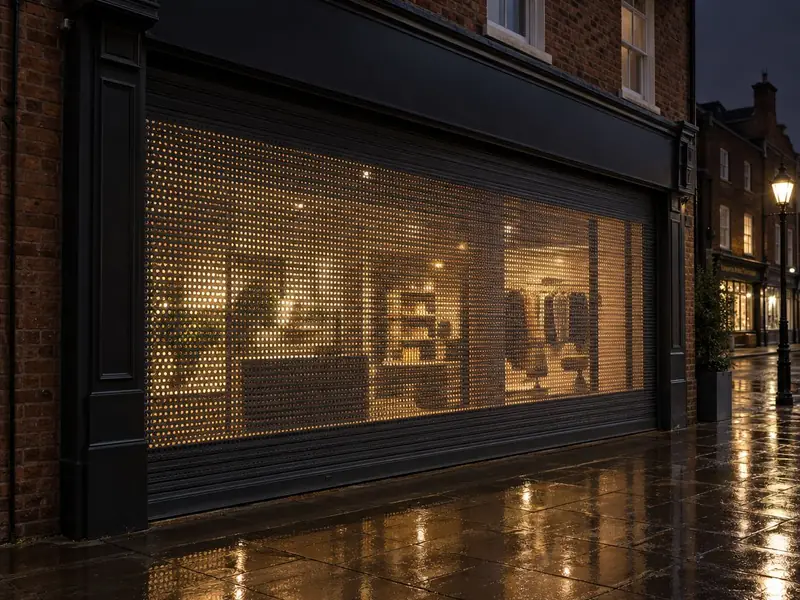
What is the difference between perforated and solid shutters?
Both are roller shutters made from interlocking steel or aluminium laths that coil into a box above the opening. The difference is in the laths. Solid laths are plain, so the closed shutter forms a continuous sheet of metal. Perforated laths are punched with a pattern of small holes across most of their face, so light passes through and people outside can make out lighting, colour and shapes, though not much detail.
Two related options sit further along the visibility scale: punched-lath vision shutters, with larger slots filled with clear polycarbonate, and open-grille shutters made from rods and links. Both are covered in our grilles or shutters guide.
How do perforated and solid shutters compare?
| Factor | Solid | Perforated |
|---|---|---|
| Visibility when closed | No view through | Limited: light, colour and outlines |
| Privacy | Full | Partial |
| Weather and draught protection | Good | Reduced: air and some rain pass through |
| Light onto the street at night | No light shows | Some, if display lights are left on |
| Planning on high streets | Often resisted | Usually more acceptable |
| Graffiti | Large blank surface | Still a target, but less of a blank canvas |
| Guide price, electric (ex VAT) | £1,495–£2,695 | £1,695–£2,895 |
You do not always have to choose one or the other. On many shutter ranges a curtain can combine a solid band at the bottom, where kicks and knocks happen and low shelving sits, with perforated laths above to show the display. Some shops choose a solid curtain over the entrance and a perforated curtain over the window. We confirm what the chosen range allows at the survey.
Is a solid shutter more secure than a perforated one?
Not automatically. Resistance to forced entry depends largely on the lath gauge and profile, the depth of the guides, the bottom rail and its locking, the quality of the fixings and the box. Perforations remove some material, so compare specifications rather than assuming, but a sturdy perforated shutter can outperform a flimsy solid one.
Where security really matters, look for a product tested to a recognised standard. Our LPS 1175 guide explains the ratings insurers use.
What a solid shutter does offer is concealment. If thieves cannot see the stock, they cannot pick a target, which matters for shops holding phones, tobacco or alcohol.
Why do councils often prefer perforated shutters?
A street lined with solid shutters looks closed and can feel unwelcoming after dark. Perforated shutters let window lighting fall onto the pavement and let passers-by and patrols see into the shop, which supports natural surveillance and keeps the street looking active. That is why many council shopfront guides prefer perforated, punched-lath or grille designs to solid ones.
Planning permission is normally needed for an external shutter either way. Choosing perforated simply improves the chances of approval in many areas. Our planning guide covers the process.
When is a solid shutter the better choice?
- Rear and service doors, where appearance matters less and full weather protection helps.
- High-value stock that should not be visible from the street after hours, where planning allows a solid curtain.
- Exposed sites facing driving rain, wind-blown grit or coastal weather.
- Openings that need insulation, where a foam-filled insulated aluminium shutter can reduce heat loss and draughts.
- Units with no window display, such as stores or plain-fronted premises, where visibility adds little.
When does a perforated shutter make more sense?
- Window-led retail, such as fashion, gifts and estate agents, where an evening display still does a job.
- Conservation areas and town centres with design guides that favour visibility.
- Shops relying on passing patrols or CCTV to spot activity inside.
- Streets where neighbours already have perforated shutters, so the parade looks consistent.
If you want more visibility than perforations give, a punched-lath vision shutter shows the display clearly while still closing off the opening.
Does a perforated shutter affect lighting and running costs?
A perforated shutter only shows off the window if the display is lit. Many retailers put window lighting on a timer for a few hours after closing, and LED fittings keep the running cost modest. Check that your insurer is comfortable with lights being left on and stock being partly visible.
A solid shutter makes evening display lighting pointless, but on an older single-glazed shopfront it may cut draughts slightly more than a perforated one. For a meaningful improvement in heat loss, an insulated shutter is the product designed for the job. Insulated laths are solid by nature, so they suit stores, rear doors and plain frontages rather than display windows.
Do perforated and solid shutters need different maintenance?
The mechanics are the same: guides, bottom rail, barrel, springs or motor, and limit settings all need the same checks at a service visit. The differences are mostly about the curtain surface.
- Perforated curtains collect dust and grime in the holes, especially near busy roads. A wash with mild detergent and a soft brush every few months keeps them looking presentable.
- Solid curtains show graffiti, dents and scuffs more obviously because there is nothing to break up the surface. Prompt removal stops paint taking hold, and a powder-coated finish usually cleans up better than bare galvanised steel.
- Both benefit from keeping the guide channels clear of litter, leaves and grit, which can make a shutter run rough or stop it closing fully.
Our service visits cover both types, from £125 per shutter.
What questions should I ask before choosing?
- Does the council publish a shopfront design guide, and what does it say about shutters?
- Does my insurer require a particular type or security rating?
- Do I want the window display to work after closing time?
- Is the opening exposed to driving rain or wind?
- How visible is the stock from the street, and does it attract thieves?
- What have neighbouring shops fitted, and were those shutters approved?
The answers usually make the choice obvious. If they pull in different directions, for example an insurer wanting maximum protection on a street where the council prefers visibility, a tested product with a vision or perforated curtain may satisfy both, subject to your insurer and council confirming.
Questions about this guide
Can people see into my shop through a perforated shutter?
Partly. With lights on inside, people can see light, colour and the outline of displays, but not fine detail, and the effect is weaker by day. With the lights off, very little is visible. If you want shoppers to see products clearly after closing, a punched-lath vision shutter or an open grille gives a much clearer view.
Will rain get through a perforated shutter?
Some wind-driven rain and air can pass through the perforations, so the shopfront behind still gets some exposure. On a normal glazed shopfront this is rarely a problem. On an open-fronted unit without glazing, or a doorway facing the prevailing weather, a solid or insulated shutter keeps more of the weather out.
Are perforated shutters harder to keep clean?
They need a little more care, because dirt can collect in the holes and graffiti paint can get into the perforations. A powder-coated finish is easier to wipe down than bare galvanised steel. Avoid pressure-washing directly into the guides, and use cleaning products suitable for the finish.
Can a solid shutter be converted to perforated?
Drilling the existing laths is not a good idea, because it weakens them and damages the finish. The practical route is a new perforated curtain or a whole new shutter. Sometimes the existing box, guides and motor can be reused with a new curtain if they are compatible and in good condition, which a survey can confirm.
Sources
- When is permission required? (GOV.UK planning guidance)
- Historic environment (GOV.UK planning guidance)
This guide is general information, not legal advice. Your local planning authority, landlord and insurer have the final say on your premises.