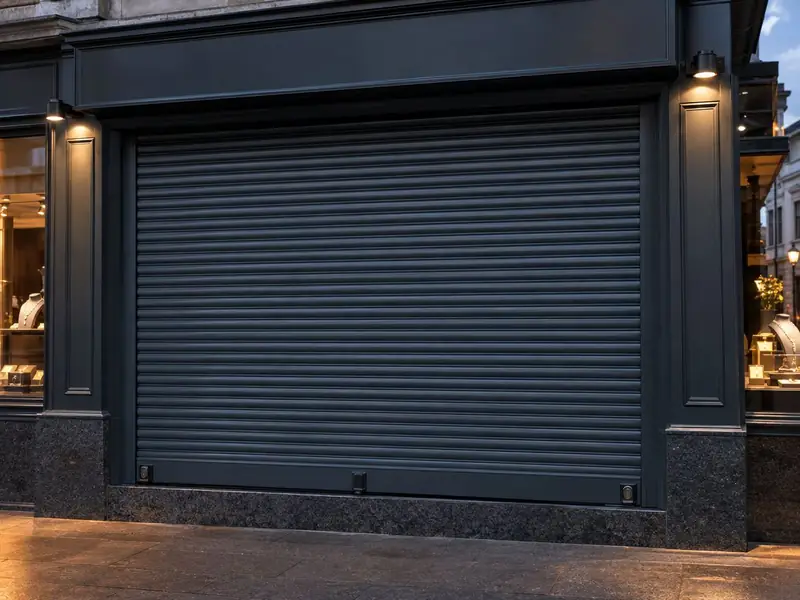
What is LPS 1175?
LPS 1175 is a Loss Prevention Standard published by BRE Global and used by the Loss Prevention Certification Board (LPCB) to certify security products. It covers building components such as roller shutters, doors, grilles, windows and enclosures, and sets out how they are attacked in testing and what they must withstand to achieve each rating.
In testing, trained attackers use a defined set of tools against the product for a set time, looking for a way through. A product that resists for long enough at a given tool level earns the rating. Certification also involves checks on how the product is made, so that the shutters sold match the one that was tested.
Insurers, specifiers and police crime-prevention advisers use LPS 1175 ratings as a common language for physical security.
How do Issue 8 ratings work?
Issue 8 of the standard uses a two-part rating:
- A letter from A to H describes the threat level, meaning the category of tools available to the attacker. A covers simple hand tools that could be carried discreetly; each step up adds more powerful tools, through to H at the top of the scale.
- A number gives the delay, in minutes, that the product achieved against that tool category in testing.
So a B3 rating indicates a product that resisted the B tool set for at least three minutes of testing, and a C5 rating indicates resistance to the larger C tool set for at least five minutes. The higher the letter and the number, the greater the resistance.
The delay time refers to time spent actively attacking in test conditions. It is not a promise of how long a shutter would last against a real attack, which depends on the attacker, the tools and the building around it.
How do the old SR ratings compare?
Issue 7 and earlier used security ratings from SR1 to SR8, and many insurance policies and older specifications still refer to them. The Issue 8 ratings broadly correspond as follows:
| Issue 7 rating | Broadly corresponds to Issue 8 |
|---|---|
| SR1 | A1 |
| SR2 | B3 |
| SR3 | C5 |
| SR4 | D10 |
| SR5 | E10 |
| SR6 | F10 |
| SR7 | G10 |
| SR8 | H20 |
The comparison is a guide, not an exact equivalence, because the test methods changed between issues. If your insurer specifies an SR rating, ask them in writing whether a product certified to the corresponding Issue 8 rating is acceptable.
Which rating does a shop need?
Many shops do not need a rated shutter at all; a well-made standard shutter suits a wide range of premises. A rating becomes relevant when an insurer asks for one, when stock is especially attractive to thieves, or when a site has a history of determined attacks.
Insurers set their own requirements, and the same retailer may be asked for different ratings by different insurers. Shops holding jewellery, phones, tobacco, alcohol or pharmacy stock are among those more likely to be asked for a rated product. The insurer's written requirement should decide the rating, not a guess. See our guide to what insurers want.
How do I check that a shutter is genuinely certified?
Certified products are listed in the LPCB Red Book, which can be searched online. To check a product:
- Ask for the manufacturer's name, the product name and the certificate reference.
- Search the Red Book listing and confirm the certificate is current.
- Check that the rating listed matches the rating you have been offered.
- Check the listed limits, such as maximum width and height, and the approved locking, guides and fixings.
Certification belongs to the manufacturer's tested product. We supply LPS 1175 certified shutters and quote the manufacturer's certificate reference with our specification; we do not hold LPCB certification ourselves.
Does installation affect the rating?
It can. A certified shutter is tested in a particular configuration, and the rating relies on it being made within the certified size range and installed as the manufacturer's instructions require, using the specified fixings into suitable masonry, steel or concrete. Fixing a rated shutter into soft brickwork, cutting down guides or swapping locks can undermine the protection it was designed to give.
At the survey we check the structure around the opening. If the surrounding wall or frame is weak, it may need strengthening, or a steel subframe may be needed, so that the building is not the easy way in.
What does an LPS 1175 shutter cost?
Guide prices start from £3,495 for an SR1 or A1 rated shutter on a typical single shopfront of about 3 m by 2.5 m, rising to £6,995 or more for higher ratings, excluding VAT. Rated products use heavier laths, deeper guides, reinforced bottom rails and specific locking, which explains much of the difference from a standard shutter.
Your price is confirmed in writing after a free survey. Our high-security shutters page sets out the products we supply.
Is LPS 1175 the only security standard for shutters?
No. Other standards exist, including BS EN 1627, which classifies the burglar resistance of doorsets, windows, grilles and shutters using resistance classes. Some insurers accept more than one standard; others name LPS 1175 specifically. Check which standard and rating your insurer will accept before ordering, and keep that confirmation with your policy documents.
A security rating is also separate from the product standard for doors and shutters, BS EN 13241, and the safety-in-use standard for powered doors, BS EN 12453. A rated electric shutter still needs to be safe to operate, with the right controls and safety devices.
What else protects a shop alongside a rated shutter?
A rated shutter delays an attacker, but delay only helps if someone responds. Insurers and crime-prevention advisers usually look at security as layers working together:
- Detection. An intruder alarm, ideally monitored, so that an attack on the shutter raises an alert while the delay is still running.
- The rest of the building. Rear doors, roof lights, side windows and party walls with neighbouring units can be weaker than the shopfront.
- Stock handling. Moving the most valuable items into a safe or locked store overnight reduces the reward for an attack.
- Lighting and cameras. Good lighting and visible CCTV can discourage an attack before it starts.
Think of the rating as one part of the plan, sized to the risk, rather than the whole answer.
Questions about this guide
Is a higher LPS 1175 rating always better?
Not for every shop. Higher ratings bring heavier, more expensive shutters and may need structural work around the opening. The right rating is the one your insurer requires and your risk justifies. Over-specifying adds cost without necessarily improving your cover, while under-specifying could leave you outside your policy conditions.
Does an LPS 1175 rating apply to perforated shutters?
It can. Ratings belong to specific tested products, and some manufacturers certify perforated or vision curtains as well as solid ones. Check the Red Book listing for the exact product and curtain type, because a rating for a solid version does not automatically extend to a perforated version of the same range.
Are you LPCB certified?
No. LPCB certification belongs to the manufacturer and its tested product. We supply LPS 1175 certified shutters, install them in line with the manufacturer's instructions, and provide the manufacturer's certificate reference so that you or your insurer can check the listing in the Red Book.
Will my existing shutter have an LPS 1175 rating?
Only if it was supplied as a certified product. Look for a label on the shutter, the original specification or the certificate reference in your paperwork, then check the Red Book. If none can be found, assume it is unrated. Our technicians can note what is fitted during a service visit.
Sources
- RedBook Live (LPCB listings of certified fire and security products)
- RedBook Live search: check a certificate or listing
- Red Book Part 4: Security protection products (LPCB)
This guide is general information, not legal advice. Your local planning authority, landlord and insurer have the final say on your premises.