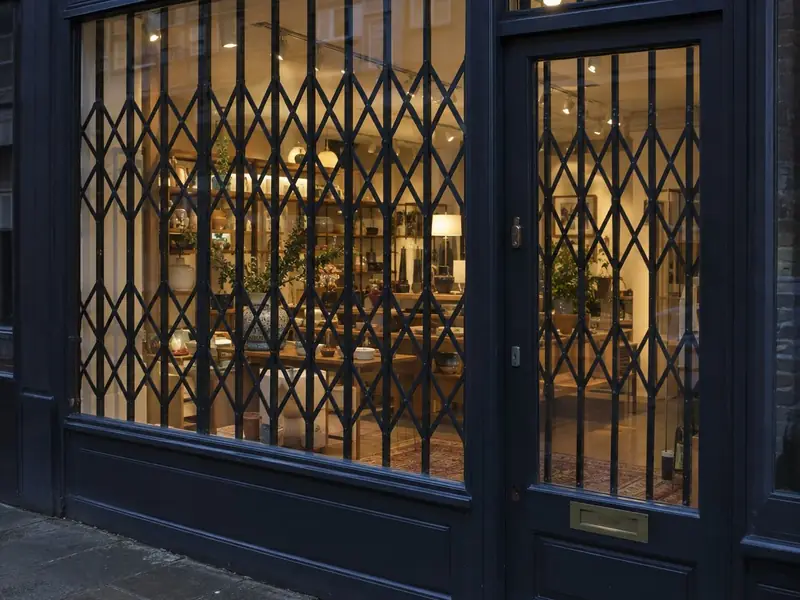
What is the difference between a grille and a shutter?
A roller shutter has a curtain made of interlocking laths, which can be solid, perforated, or punched and fitted with clear polycarbonate inserts. It coils into a box above the opening.
A security grille is an open framework of bars or links. There are two main types:
- Retractable or collapsible grilles slide sideways on top and bottom tracks and fold into a compact stack at one or both sides of the opening.
- Roller grilles, also called open-grille shutters, are made of rods and links, often in a brick-bond or tube-and-link pattern, and coil into a box just like a shutter.
How do the main options compare?
| Option | Visibility | Glass protection | Weather protection | Guide price (ex VAT) |
|---|---|---|---|---|
| Retractable grille | High | Limited | No weather cover | £495–£1,195 |
| Open grille roller shutter | High | Limited | No weather cover | £1,595–£2,795 |
| Punched-lath vision shutter | Good | Good | Partial | £2,195–£3,695 |
| Perforated electric shutter | Limited | Good | Partial | £1,695–£2,895 |
| Solid electric shutter | No view through | Good | Good | £1,495–£2,695 |
Prices are guide ranges for a typical single shopfront of about 3 m by 2.5 m, except retractable grilles, which are usually fitted to smaller openings. Your price is confirmed in writing after a free survey.
When is a grille the better choice?
- Window displays that sell after hours, such as fashion, gifts, furniture or estate agents.
- Conservation areas and high streets where the council's design guide favours open, visible frontages.
- Indoor units in shopping centres and arcades, where weather is not a concern and the landlord may require an open frontage.
- Ventilation, for example on a lobby, an internal stockroom door or an open-fronted unit that needs airflow at night.
- Doorways and recessed lobbies, where a retractable grille can close off the space without a box above.
When is a roller shutter the better choice?
- Glass is a target. Grilles leave gaps through which glass can still be struck, so a solid, perforated or vision shutter protects it better.
- Stock should be hidden. Phones, tobacco, alcohol and similar goods are better kept out of sight.
- The site is exposed. Rain, wind-blown litter and grit pass straight through a grille.
- Your insurer specifies a shutter or a rated product that is only available as a shutter.
- Privacy matters, for example in a clinic, salon or office-style unit.
Our perforated or solid guide helps narrow down which shutter suits.
What should I know about retractable grilles?
Retractable grilles are often the lowest-cost way to secure a doorway or a small window, and they need no box above the opening. Points to consider:
- Stack space. When open, the grille folds into a stack at the side of the opening, which takes up wall space and can partly cover a display.
- Tracks. A bottom track can be a trip hazard or collect dirt. Some designs allow a recessed track or none at all; we check what suits your threshold.
- Locking. Grilles are locked by hand, usually with a key lock or padlock.
- Size. They suit doorways and smaller openings best; very wide frontages are usually better served by a roller grille or shutter.
- Daily handling. Staff pull the grille across and lock it by hand each night, so check that the weight and the position of the lock suit the people who will close up.
See our security grilles page for the options.
Are vision shutters a middle ground?
Yes. A punched-lath vision shutter has laths with slots filled with clear polycarbonate, so the display is visible while the curtain still forms a continuous barrier. It protects the glass better than an open grille and shows more than a perforated shutter. The trade-off is cost, with a guide price of £2,195–£3,695, ex VAT, and polycarbonate inserts that can scratch or dull over time if cleaned with abrasive products. Our punched-lath shutters page explains the options.
Are there planning or fire safety rules to check?
Planning permission
An external roller grille or shutter usually needs planning permission because it changes the appearance of the building. Councils often look more favourably on grilles and vision shutters than on solid shutters, but approval is not automatic. A retractable grille fitted behind the glass usually does not need permission unless the building is listed or a planning condition controls the shopfront. Ask your council before ordering, and see our planning guide for the process in each UK nation.
Fire exits
A grille or shutter must not obstruct an escape route while people are in the building. If a grille secures an exit door, it must be fully open whenever the premises are occupied, and the arrangement should be covered in the fire risk assessment. Talk to whoever is responsible for fire safety in the building before fitting any grille or shutter across a route people may need to use in an emergency.
Can grilles and shutters be combined on one shopfront?
Yes, and on many frontages a mix gives the best result. Common combinations include:
- a solid or perforated shutter over the main window, with a retractable grille across a recessed doorway;
- a vision shutter on the street frontage and a counter shutter inside to secure a till point, kiosk or serving hatch;
- an open grille on the frontage of a unit in a covered arcade, with a solid shutter on the rear service door;
- an internal grille behind laminated glass where the council will not accept anything external.
Using the same colour and similar detailing across each element keeps the frontage looking like one design rather than a collection of add-ons.
What questions help decide between a grille and a shutter?
- Is the glass itself likely to be attacked or vandalised?
- Does the window display need to work after closing time?
- Is the opening exposed to wind, rain or litter?
- Does your insurer name a product type or security rating?
- What does the council's shopfront guidance prefer?
- Is there room for a box above the opening, or stack space at the sides?
- Will the opening be used as an escape route while people are inside?
If the answers point in different directions, a vision shutter or a layered combination is often the compromise. We talk through the options at the free survey for new shutters and grilles.
Questions about this guide
Is a grille less secure than a shutter?
Not necessarily against someone trying to get in, because a well-made grille can be strong and hard to cut. The difference is that it leaves the glass and display exposed, so smash-and-grab theft through the bars and damage to the glass remain possible. Where glass protection or hidden stock matters, a shutter is usually the better choice.
Can a roller grille be electric?
Yes. Roller grilles coil into a box like a shutter, so they can be motorised with the same controls and safety devices. Retractable grilles are operated by hand. If you want push-button operation and good visibility, an electric open-grille or punched-lath shutter is the usual choice.
Can I use a grille inside the shop and a shutter outside?
Yes, and it is a sensible layered approach. An external shutter protects the frontage, while an internal grille can secure a stockroom, a high-value display or an area behind a counter. It also means that if the outer layer is breached, there is still a barrier between an intruder and the most valuable stock.
Do grilles work in shopping centres?
They are common in enclosed centres, where there is no weather to keep out and landlords often want shop fronts to stay visible after hours. Most centres control the design, colour and position through a fit-out guide, so get the landlord's written approval before ordering, and check the centre's fire strategy.
Sources
- BS EN 13241: Industrial, commercial and garage doors and gates product standard (BSI)
- Fire safety in the workplace: who's responsible (GOV.UK)
- When is permission required? (GOV.UK planning guidance)
This guide is general information, not legal advice. Your local planning authority, landlord and insurer have the final say on your premises.