Is it actually a power cut?
Before reaching for the override, check whether the problem is the mains supply or the shutter itself:
- Are the shop's lights, tills and other equipment off too?
- Are neighbouring shops and street lights affected?
- Has a breaker tripped in your consumer unit, or has the shutter's isolator or fused spur been switched off?
If only the shutter has no power, the cause is local; see our guide to a shutter that will not open or close. If the whole area is off, check your electricity network operator's power cut information for an estimated restoration time. If power is expected back soon, waiting may be simpler than winding.
What types of manual override are there?
The override depends on the motor fitted. The common types are:
| Override | How it works | Where you will usually find it |
|---|---|---|
| Hand chain | An endless chain loop turns the barrel through a gearbox | Hanging beside the shutter, often on external-motor systems |
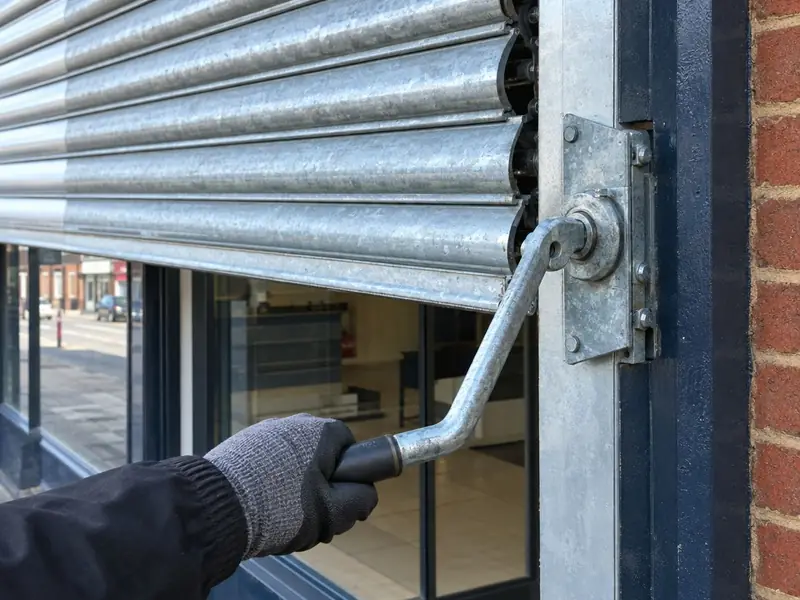
| Crank or winding handle | A removable handle fits into an eye on the motor or gearbox and is turned to wind the curtain | Inside the shop, below the box; the handle is stored separately |
| Manual release | Disengages the motor drive so a spring-balanced curtain can be moved by hand | On some systems only, as set up by the installer |
| Battery backup | A battery unit keeps the motor running for a limited number of cycles | Inside the shop, near the controls |
Not every motor has every option, and some older or budget motors have no practical override at all.
How do I use the override safely?
- Switch off the shutter's isolator, unless your installer has advised otherwise, so the motor cannot start unexpectedly when power returns while a handle is fitted.
- Release any manual locks on the bottom rail or guides.
- Clear people, stock and vehicles from under and around the curtain.
- Fit the handle or take hold of the chain exactly as you were shown at handover.
- Wind steadily. Expect it to take many turns and several minutes.
- Stop before the curtain reaches its fully open or closed position, so that you do not overwind it.
- Stop altogether if it becomes much harder to turn, jams or makes unusual noises.
- Remove the handle and store it securely, then lock the shutter if you have closed it.
What should I never do in a power cut?
- Never force the curtain with a bar, a jack or a vehicle.
- Never open the box or remove covers to get at the motor unless your installer has shown you that this is the intended route to the override.
- Never adjust or release springs.
- Never stand or work under a partly raised curtain.
- Never leave the winding handle where the public can reach it.
- Never improvise a handle from other tools; the wrong fit can slip and injure you or damage the gearbox.
What if the shutter is my only way in?
This is the situation to plan for in advance. If the shopfront shutter covers your only entrance and the override can only be reached from inside, a power cut overnight could leave you locked out in the morning.
Solutions include an external override point, usually key-operated, a battery backup unit, or a second entrance with its own lock. Check now where your override is and whether you can reach it from outside. If you cannot, ask about options at your next service.
Is battery backup worth having?
Battery backup lets the motor carry on working for a limited number of cycles after the mains fails. It can make sense if:
- the shutter covers your only entrance;
- outages are common in your area;
- the curtain is large and winding by hand is slow or difficult;
- staff who open up are not confident using the manual override.
Batteries need checking and eventually replacing, and not every motor is compatible. We quote battery backup individually after checking the motor. If your motor is old or has no usable override, a motor replacement may be the better long-term fix.
What if the power goes off at closing time?
Do not leave the shop unsecured if you can avoid it. Use the override to close the shutter, engage any manual locks, and remove and store the handle. If you cannot close it, consider temporary measures such as staying on site until power returns or arranging boarding, and let your insurer or broker know, because many policies require shutters to be closed and locked whenever the shop is unattended.
What should I check when the power comes back?
Remove any handle, switch the isolator back on and run the shutter through one full cycle while watching it. Check that it stops at the right positions, that the safety edge and photocells still work, and that remotes and timers respond. If it behaves differently from before, stops short or makes new noises, book a repair visit rather than carrying on.
If the curtain was wound part-way by hand, some motors need to complete a full cycle before they stop accurately at the top and bottom again. Watch closely the first time, and stop the shutter if it looks as if it will overrun.
How do I prepare staff before a power cut happens?
A power cut is the worst time to discover that nobody knows where the handle is. A few minutes of preparation helps:
- ask your installer or service technician to demonstrate the override and let each key holder try it under supervision;
- agree a fixed, secure place for the winding handle, and check it is still there from time to time;
- write short instructions, with photos, and keep them with the handle and in the opening-up procedure;
- make sure key holders know where the isolator and consumer unit are;
- keep a torch near the shutter, because outages often happen in the dark.
At each service, ask the technician to confirm that the override still works smoothly. An override that has not been used for years can stiffen, and it is better to find that out on a routine visit.
Questions about this guide
The override handle is missing. What should I do?
Do not improvise with other tools, because handles are matched to the motor's override and the wrong fit can slip. Contact us or your original installer with photos of the motor or box label. Once the motor type is identified, a suitable handle can often be supplied. Keep the replacement somewhere staff can find it.
How long does it take to wind a shutter by hand?
It depends on the shutter's height and the gearing of the override. Winding can take many turns and several minutes, which is normal. If the handle becomes much harder to turn, stops dead or the curtain moves unevenly, stop and call a technician rather than applying more force.
Does every electric shutter have a manual override?
Most shop shutter motors have some form of override, but not all, and on some installations it is fitted in an awkward or inaccessible place. If you are not sure what yours has, ask at your next service. Fitting a different motor or adding battery backup are possible solutions.
Can a power cut damage the shutter motor?
A power cut on its own does not usually harm the motor. If the shutter does not work once power returns, check the breaker, fused spur and isolator first. If those are fine and it still will not run, or it runs erratically, the controls may need attention from a technician.
Sources
- Workplace (Health, Safety and Welfare) Regulations 1992, regulation 18
- Powered gates: the basics (HSE)
This guide is general information, not legal advice. Your local planning authority, landlord and insurer have the final say on your premises.