Solid steel shop shutters in Workington: what to expect
Before quoting in Workington, we confirm who owns the frontage, whether the lease restricts external alterations and whether the building is listed or in a conservation area. Sorting that early avoids paying for something that cannot be fitted.
Shopfronts differ a lot, from Victorian parades with timber fascias to modern aluminium units, and the right specification depends on which you have. At survey in Workington we check the depth behind the fascia, the condition of the reveals and the route for any power supply, so the quote reflects your actual frontage rather than a catalogue size.
Our coverage around Workington takes in Whitehaven, Carlisle, Penrith and the wider Cumbria area.
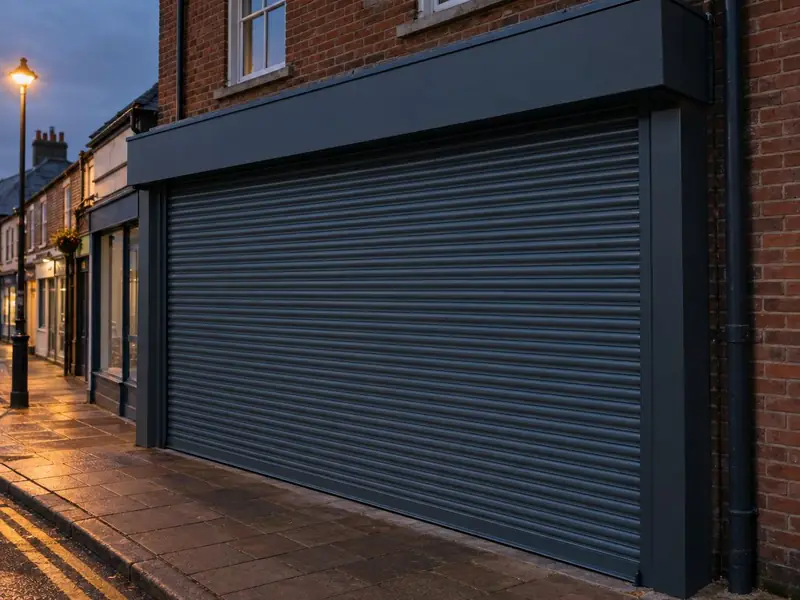
About our solid steel shop shutters
Full-cover galvanised steel laths for maximum privacy and weather protection.
- Face-fit, under-fascia or concealed behind the fascia
- Lockable bottom rail with ground or side locks
- Manual override fitted to electric shutters
- Optional key switch, remote or timer on electric versions
| Finish | Galvanised or powder coated (RAL) |
|---|---|
| Vision | No vision panels, fully solid |
| Curtain | Roll-formed galvanised steel laths, 75–77 mm |
More detail on our solid steel shop shutters page.
What solid steel shop shutters cost in Workington
| Option | Guide price ex VAT | Inc VAT |
|---|---|---|
| Solid steel, electric, box hidden behind the fascia | £1,995–£3,495 | £2,394–£4,194 |
| Solid steel, electric, face-fit box Recommended | £1,495–£2,695 | £1,794–£3,234 |
| Solid steel, manual | £895–£1,495 | £1,074–£1,794 |
Guide prices, supply and fit, for a typical shopfront about 3 m × 2.5 m unless stated. Your fixed price is confirmed in writing after a free survey, before any work starts.
Do shutters in Workington need planning permission?
In England, an external shutter on a shopfront is normally treated as development that needs planning permission from your local planning authority, because it changes how the building looks. There is no permitted development right for shop shutters. Internal shutters fitted behind the glass usually sit outside planning control.
Listed buildings need listed building consent for works affecting their character, inside or out, and conservation areas bring closer scrutiny of the design. Many councils publish a shopfront design guide that prefers perforated, punched or internal shutters with the box hidden behind the fascia.
Four steps to a new shutter
Send your details
Use the form, freephone or chat to tell us what you need. A short description and a photo help us bring the right information to the survey.
Free survey
We measure the opening, check the fascia, fixings and power, and talk through planning and landlord consent.
Quote in writing
We send the specification and a fixed price in writing, with a deposit only on acceptance.
Made, fitted, explained
The shutter is made to measure and fitted, then we show you how to use it and the manual override, and leave the paperwork.
Questions from shop owners in Workington
Can you match my Workington shopfront's colour?
Yes. Laths, box and guides can be powder coated to a RAL colour so the shutter matches your shopfront frame or fascia, which councils often prefer.
How quickly can a shutter be fitted in Workington?
Shutters are made to measure after the survey and any planning approval, then most single shopfronts are fitted in a day. We confirm a realistic programme in writing with your quote rather than promising a date we cannot keep.
Is a solid shutter more secure than a perforated one?
Not automatically. Security depends on the lath gauge, the guides, the bottom-rail locking and how the shutter is fixed. A solid curtain hides the interior, which deters opportunists, but a well-specified perforated shutter can resist the same tools. If your insurer names a rating, we quote a certified product.
How long does fitting take?
Most single shopfront shutters are fitted in a day once made. Larger openings, concealed boxes or electrical work can add time, and we confirm the plan in writing after the survey.