Planning solid steel shop shutters in Pontypool
Shopfronts differ a lot, from Victorian parades with timber fascias to modern aluminium units, and the right specification depends on which you have. At survey in Pontypool we check the depth behind the fascia, the condition of the reveals and the route for any power supply, so the quote reflects your actual frontage rather than a catalogue size.
Before quoting in Pontypool, we confirm who owns the frontage, whether the lease restricts external alterations and whether the building is listed or in a conservation area. Sorting that early avoids paying for something that cannot be fitted.
Nearby, we also cover Cwmbran, Risca and Blackwood; Pontypool is about 8 miles from Newport.
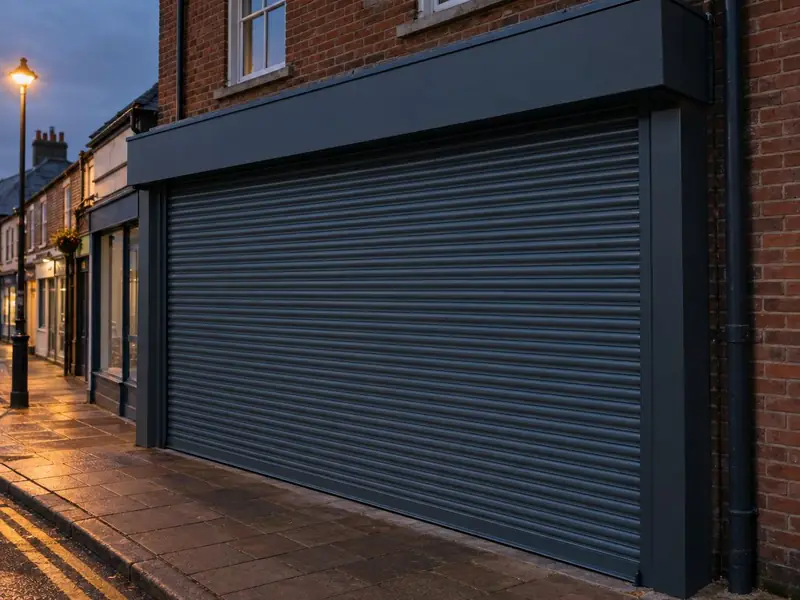
What our solid steel shop shutters include
Full-cover galvanised steel laths for maximum privacy and weather protection.
- Galvanised steel laths, single-wall as standard, double-wall on request
- Lockable bottom rail with ground or side locks
- Optional key switch, remote or timer on electric versions
- Manual (crank or push-up) or electric operation
| Operation | Manual or electric |
|---|---|
| Curtain | Roll-formed galvanised steel laths, 75–77 mm |
| Finish | Galvanised or powder coated (RAL) |
More detail on our solid steel shop shutters page.
Guide prices in Pontypool
| Option | Guide price ex VAT | Inc VAT |
|---|---|---|
| Solid steel, electric, box hidden behind the fascia | £1,995–£3,495 | £2,394–£4,194 |
| Solid steel, electric, face-fit box Recommended | £1,495–£2,695 | £1,794–£3,234 |
| Solid steel, manual | £895–£1,495 | £1,074–£1,794 |
Guide prices, supply and fit, for a typical shopfront about 3 m × 2.5 m unless stated. Your fixed price is confirmed in writing after a free survey, before any work starts.
Planning rules for shutters in Pontypool
In Wales, your local planning authority decides whether an external shop shutter needs planning permission, and in practice one is normally required because the shutter changes the frontage. Shutters fitted inside the shop, behind the glass, usually fall outside planning control.
Cadw is the heritage body for Wales. Under the Historic Environment (Wales) Act 2023, listed buildings still need listed building consent for works that affect their character, and conservation areas bring closer attention to design, so it is worth asking the council for pre-application advice.
Four steps to a new shutter
Tell us about the shop
Send the postcode, the opening size if you know it and a photo if you can. We reply to arrange a survey.
Measure and check
We confirm sizes, fixings and power on site, and note anything that affects planning or the box position.
Agree the price
Your written quote sets out exactly what is included. Payment terms on installations are 50% deposit, 40% on the first day of fitting and 10% on completion.
Made, fitted, explained
The shutter is made to measure and fitted, then we show you how to use it and the manual override, and leave the paperwork.
Common questions
How quickly can a shutter be fitted in Pontypool?
Shutters are made to measure after the survey and any planning approval, then most single shopfronts are fitted in a day. We confirm a realistic programme in writing with your quote rather than promising a date we cannot keep.
Will I need planning permission for a shutter in Pontypool?
An external shutter normally needs planning permission from the local planning authority, while internal shutters behind the glass usually do not. Listed buildings and conservation areas need extra care. We provide the shutter specification for your application.
Will a solid shutter rust?
Galvanised steel resists corrosion well, and powder coating adds a further barrier. Coastal sites and damaged coatings need more attention, which is why we suggest an annual service.
Do solid shop shutters need planning permission?
An external solid shutter usually needs planning permission because it changes how the shopfront looks, and many councils prefer perforated, punched or internal shutters in town centres. We provide the shutter specification for your application, and the final decision always sits with your local planning authority.