Solid steel shop shutters in Tunbridge Wells: what to expect
Every opening is measured on site. In Tunbridge Wells, as anywhere, we look at headroom above the glazing, side room for guide rails, the ground the bottom rail will close onto and any outward-opening doors, because each of these changes how the shutter is specified and fixed.
Shopfronts differ a lot, from Victorian parades with timber fascias to modern aluminium units, and the right specification depends on which you have. At survey in Tunbridge Wells we check the depth behind the fascia, the condition of the reveals and the route for any power supply, so the quote reflects your actual frontage rather than a catalogue size.
We also work in Tonbridge and Crowborough, so a visit in Tunbridge Wells can usually be fitted around others in Kent.
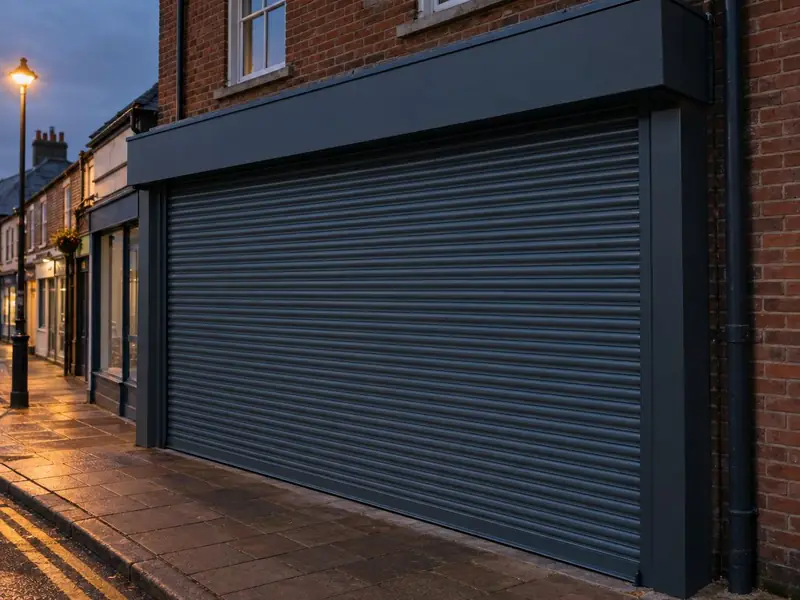
What's included
Full-cover galvanised steel laths for maximum privacy and weather protection.
- Optional key switch, remote or timer on electric versions
- Lockable bottom rail with ground or side locks
- Galvanised steel laths, single-wall as standard, double-wall on request
- Manual override fitted to electric shutters
| Typical box | 205–300 mm depending on drop |
|---|---|
| Curtain | Roll-formed galvanised steel laths, 75–77 mm |
| Vision | No vision panels, fully solid |
More detail on our solid steel shop shutters page.
What solid steel shop shutters cost in Tunbridge Wells
| Option | Guide price ex VAT | Inc VAT |
|---|---|---|
| Solid steel, electric, box hidden behind the fascia | £1,995–£3,495 | £2,394–£4,194 |
| Solid steel, electric, face-fit box Recommended | £1,495–£2,695 | £1,794–£3,234 |
| Solid steel, manual | £895–£1,495 | £1,074–£1,794 |
Guide prices, supply and fit, for a typical shopfront about 3 m × 2.5 m unless stated. Your fixed price is confirmed in writing after a free survey, before any work starts.
Planning rules for shutters in Tunbridge Wells
English councils generally expect a planning application before an external roller shutter goes on a shopfront, since the shutter alters the appearance of the building; shop shutters have no permitted development right. A shutter installed inside, behind the glazing, does not usually need permission.
If the building is listed, listed building consent is needed as well, and in a conservation area the council will look harder at the curtain type, box position and colour. A council shopfront guide, where one exists, is the best place to start.
Four steps to a new shutter
Tell us about the shop
Send the postcode, the opening size if you know it and a photo if you can. We reply to arrange a survey.
Survey on site
A surveyor measures up, photographs the frontage and checks headroom, side room and the ground the shutter closes onto.
Agree the price
Your written quote sets out exactly what is included. Payment terms on installations are 50% deposit, 40% on the first day of fitting and 10% on completion.
Fit and test
After fitting we test every function with you and confirm servicing recommendations in writing.
Common questions
Will I need planning permission for a shutter in Tunbridge Wells?
An external shutter normally needs planning permission from the local planning authority, while internal shutters behind the glass usually do not. Listed buildings and conservation areas need extra care. We provide the shutter specification for your application.
Can you match my Tunbridge Wells shopfront's colour?
Yes. Laths, box and guides can be powder coated to a RAL colour so the shutter matches your shopfront frame or fascia, which councils often prefer.
Can a solid shutter be painted to match my shopfront?
Yes. The laths, guides and box can be powder coated to a RAL colour at the factory, which lasts far longer than painting on site. Colour-matching to the shopfront frame is often welcomed by planning officers.
Do solid shop shutters need planning permission?
An external solid shutter usually needs planning permission because it changes how the shopfront looks, and many councils prefer perforated, punched or internal shutters in town centres. We provide the shutter specification for your application, and the final decision always sits with your local planning authority.