Manual-to-electric conversion across Hampshire
Councils across Hampshire each apply their own shopfront policies, so what is acceptable on one high street may be resisted on the next. We take that into account when we recommend a curtain, box position and colour, and we provide the specification for your application.
If you run shops in several parts of Hampshire, we can schedule visits together and keep one point of contact and one set of paperwork across every site.
Hampshire has everything from historic market-town frontages to modern units, and shutters for them differ. Our surveys look at the fascia, reveals, fixings and power on each shop rather than assuming a standard size.
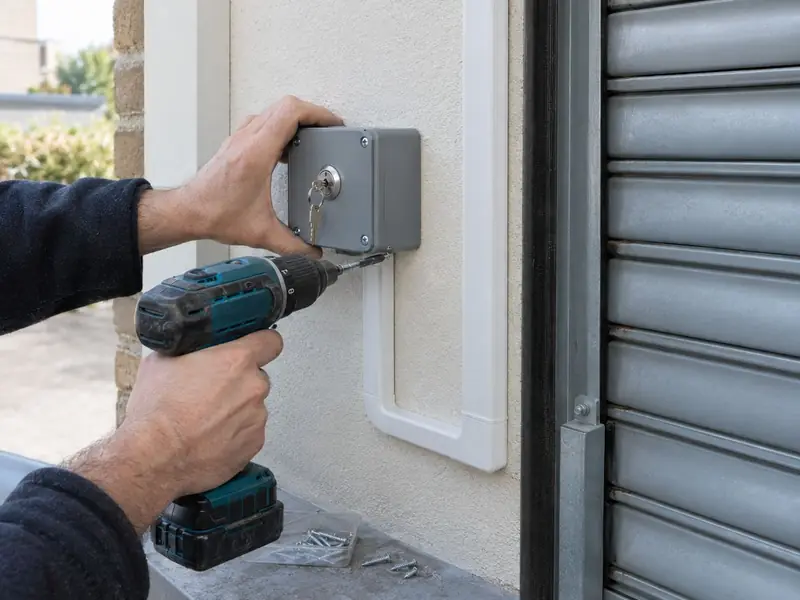
About our manual-to-electric shutter conversions
Motorise an existing manual shutter with a new drive, controls and override.
- Fused supply and wiring to BS 7671
- Limits set and override fitted
- Springs removed or adjusted by trained staff
- Usually completed in one visit
- Safety devices where controls need them
| Alternative | Replacement if unsuitable |
|---|---|
| Check | Curtain, barrel, box, springs |
| Includes | Motor, controls, wiring, override |
| Wiring | To BS 7671 |
More detail on our manual-to-electric shutter conversions page.
What manual-to-electric shutter conversions cost in Hampshire
| Option | Guide price ex VAT | Inc VAT |
|---|---|---|
| Heavier shopfront shutter, external motor | £895–£1,195 | £1,074–£1,434 |
| Standard shopfront shutter, tubular motor Recommended | £595–£895 | £714–£1,074 |
| New power supply if none is present | Priced at survey | Priced at survey |
Guide prices, supply and fit, for a typical shopfront about 3 m × 2.5 m unless stated. Your fixed price is confirmed in writing after a free survey, before any work starts.
Do shutters in Hampshire need planning permission?
In England, an external shutter on a shopfront is normally treated as development that needs planning permission from your local planning authority, because it changes how the building looks. There is no permitted development right for shop shutters. Internal shutters fitted behind the glass usually sit outside planning control.
Listed buildings need listed building consent for works affecting their character, inside or out, and conservation areas bring closer scrutiny of the design. Many councils publish a shopfront design guide that prefers perforated, punched or internal shutters with the box hidden behind the fascia.
How it works
Tell us about the shop
Send the postcode, the opening size if you know it and a photo if you can. We reply to arrange a survey.
Free survey
We measure the opening, check the fascia, fixings and power, and talk through planning and landlord consent.
Agree the price
Your written quote sets out exactly what is included. Payment terms on installations are 50% deposit, 40% on the first day of fitting and 10% on completion.
Made, fitted, explained
The shutter is made to measure and fitted, then we show you how to use it and the manual override, and leave the paperwork.
Manual-to-electric conversion in Hampshire: questions
Will I need planning permission for a shutter in Hampshire?
An external shutter normally needs planning permission from the local planning authority, while internal shutters behind the glass usually do not. Listed buildings and conservation areas need extra care. We provide the shutter specification for your application.
How quickly can a shutter be fitted in Hampshire?
Shutters are made to measure after the survey and any planning approval, then most single shopfronts are fitted in a day. We confirm a realistic programme in writing with your quote rather than promising a date we cannot keep.
Will I still be able to open it by hand?
Yes. A manual override is fitted so you can operate the shutter in a power cut.
Can a push-up shutter be motorised?
Often, yes, but the springs must be dealt with by a trained technician first. We confirm at survey.