Shopfronts in Plymouth and punched lath vision shutters
Where a shop opens onto a busy pavement, safety during fitting and in daily use matters. We cordon the work area, fix guides into sound masonry or steel, and set electric controls so the person operating the shutter can see the curtain while it moves.
Every opening is measured on site. In Plymouth, as anywhere, we look at headroom above the glazing, side room for guide rails, the ground the bottom rail will close onto and any outward-opening doors, because each of these changes how the shutter is specified and fixed.
We also cover Paignton, Newton Abbot and St Austell, and the rest of Devon.
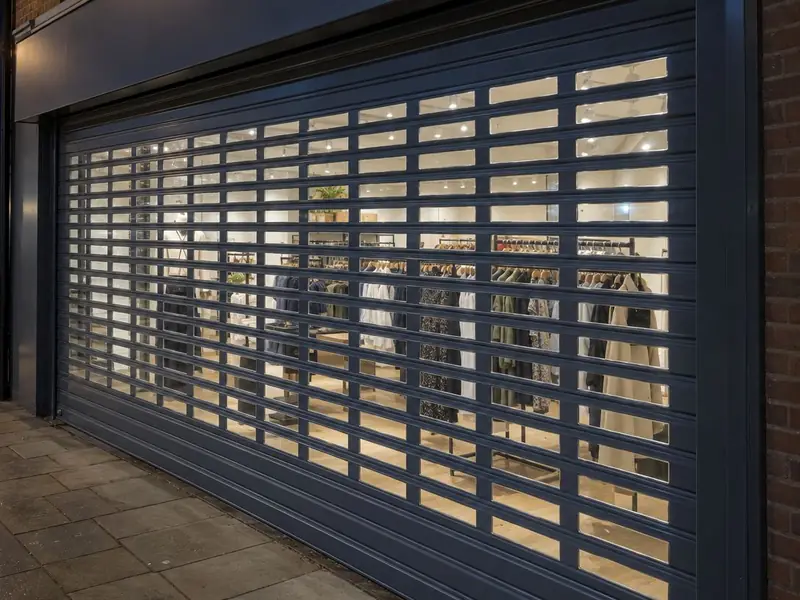
What our punched lath vision shutters include
Rows of polycarbonate windows in the laths give a clear view of the display.
- Steel laths punched with rectangular vision slots
- Powder coated to a RAL colour, often to match the frame
- Solid lower laths available for extra protection
- Clear polycarbonate inserts keep litter and hands out
| Curtain | Steel laths with polycarbonate-glazed slots |
|---|---|
| Inserts | Clear polycarbonate, replaceable |
| Operation | Electric (manual override) |
More detail on our punched lath vision shutters page.
What punched lath vision shutters cost in Plymouth
| Option | Guide price ex VAT | Inc VAT |
|---|---|---|
| Vision (punched lath), electric, box hidden behind the fascia | £2,695–£4,495 | £3,234–£5,394 |
| Vision (punched lath), electric, face-fit box Recommended | £2,195–£3,695 | £2,634–£4,434 |
| Vision (punched lath), electric, fitted inside behind the glass | £1,895–£3,395 | £2,274–£4,074 |
Guide prices, supply and fit, for a typical shopfront about 3 m × 2.5 m unless stated. Your fixed price is confirmed in writing after a free survey, before any work starts.
Planning and listed buildings in Plymouth
In England, an external shutter on a shopfront is normally treated as development that needs planning permission from your local planning authority, because it changes how the building looks. There is no permitted development right for shop shutters. Internal shutters fitted behind the glass usually sit outside planning control.
Listed buildings need listed building consent for works affecting their character, inside or out, and conservation areas bring closer scrutiny of the design. Many councils publish a shopfront design guide that prefers perforated, punched or internal shutters with the box hidden behind the fascia.
How it works
Send your details
Use the form, freephone or chat to tell us what you need. A short description and a photo help us bring the right information to the survey.
Survey on site
A surveyor measures up, photographs the frontage and checks headroom, side room and the ground the shutter closes onto.
Fixed written quote
You receive a written quote with the specification, programme and a fixed price. Nothing is ordered until you accept.
Made, fitted, explained
The shutter is made to measure and fitted, then we show you how to use it and the manual override, and leave the paperwork.
Common questions
Will I need planning permission for a shutter in Plymouth?
An external shutter normally needs planning permission from the local planning authority, while internal shutters behind the glass usually do not. Listed buildings and conservation areas need extra care. We provide the shutter specification for your application.
Can you match my Plymouth shopfront's colour?
Yes. Laths, box and guides can be powder coated to a RAL colour so the shutter matches your shopfront frame or fascia, which councils often prefer.
Can I have punched laths only at eye level?
Yes. Many shops have solid or perforated laths at the bottom and top, with vision laths in the band where people look into the window.
Are punched lath shutters less secure than solid ones?
Not necessarily. Security comes from the steel frame of the lath, the guides and the locking. If your insurer specifies a rating, we quote a manufacturer-certified product and give you its certificate reference.