Planning punched lath vision shutters in Newcastle-under-Lyme
Shopfronts differ a lot, from Victorian parades with timber fascias to modern aluminium units, and the right specification depends on which you have. At survey in Newcastle-under-Lyme we check the depth behind the fascia, the condition of the reveals and the route for any power supply, so the quote reflects your actual frontage rather than a catalogue size.
Shops in the ST5 postcode district range from convenience stores to takeaways, salons and specialist retailers. We tailor punched lath vision shutters to the stock you hold and the hours you open, and say plainly where a different option would serve you better.
Our coverage around Newcastle-under-Lyme takes in Stoke-on-Trent, Longton, Kidsgrove and the wider Staffordshire area.
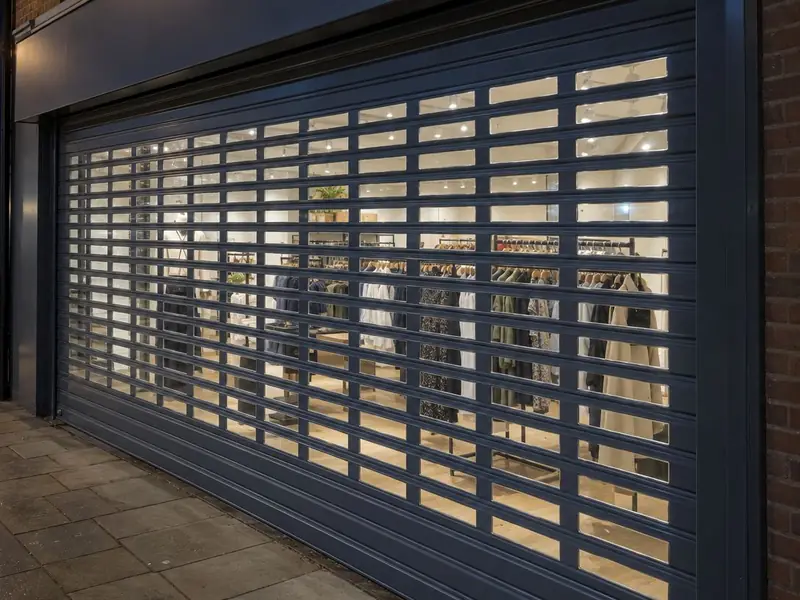
Vision (punched lath) shutters: what you get
Rows of polycarbonate windows in the laths give a clear view of the display.
- Powder coated to a RAL colour, often to match the frame
- Usually electric because of the curtain weight
- Replacement inserts available if one is scratched
- Clear polycarbonate inserts keep litter and hands out
| Inserts | Clear polycarbonate, replaceable |
|---|---|
| Finish | Powder coated (RAL) |
| Curtain | Steel laths with polycarbonate-glazed slots |
More detail on our punched lath vision shutters page.
Guide prices in Newcastle-under-Lyme
| Option | Guide price ex VAT | Inc VAT |
|---|---|---|
| Vision (punched lath), electric, box hidden behind the fascia | £2,695–£4,495 | £3,234–£5,394 |
| Vision (punched lath), electric, face-fit box Recommended | £2,195–£3,695 | £2,634–£4,434 |
| Vision (punched lath), electric, fitted inside behind the glass | £1,895–£3,395 | £2,274–£4,074 |
Guide prices, supply and fit, for a typical shopfront about 3 m × 2.5 m unless stated. Your fixed price is confirmed in writing after a free survey, before any work starts.
Planning rules for shutters in Newcastle-under-Lyme
In England, an external shutter on a shopfront is normally treated as development that needs planning permission from your local planning authority, because it changes how the building looks. There is no permitted development right for shop shutters. Internal shutters fitted behind the glass usually sit outside planning control.
Listed buildings need listed building consent for works affecting their character, inside or out, and conservation areas bring closer scrutiny of the design. Many councils publish a shopfront design guide that prefers perforated, punched or internal shutters with the box hidden behind the fascia.
What happens next
Tell us about the shop
Send the postcode, the opening size if you know it and a photo if you can. We reply to arrange a survey.
Survey on site
A surveyor measures up, photographs the frontage and checks headroom, side room and the ground the shutter closes onto.
Quote in writing
We send the specification and a fixed price in writing, with a deposit only on acceptance.
Fit and test
After fitting we test every function with you and confirm servicing recommendations in writing.
Questions from shop owners in Newcastle-under-Lyme
Is the survey free in Newcastle-under-Lyme?
The survey and written quote are free for new shutters in Newcastle-under-Lyme. Repair and service visits are charged, with a diagnostic visit from £125 ex VAT, and we tell you the cost before we attend.
Will I need planning permission for a shutter in Newcastle-under-Lyme?
An external shutter normally needs planning permission from the local planning authority, while internal shutters behind the glass usually do not. Listed buildings and conservation areas need extra care. We provide the shutter specification for your application.
Are punched lath shutters less secure than solid ones?
Not necessarily. Security comes from the steel frame of the lath, the guides and the locking. If your insurer specifies a rating, we quote a manufacturer-certified product and give you its certificate reference.
Do vision shutters need planning permission?
An external vision shutter will normally need planning permission, but councils are generally more receptive to designs that keep the display visible. Check with your local planning authority.