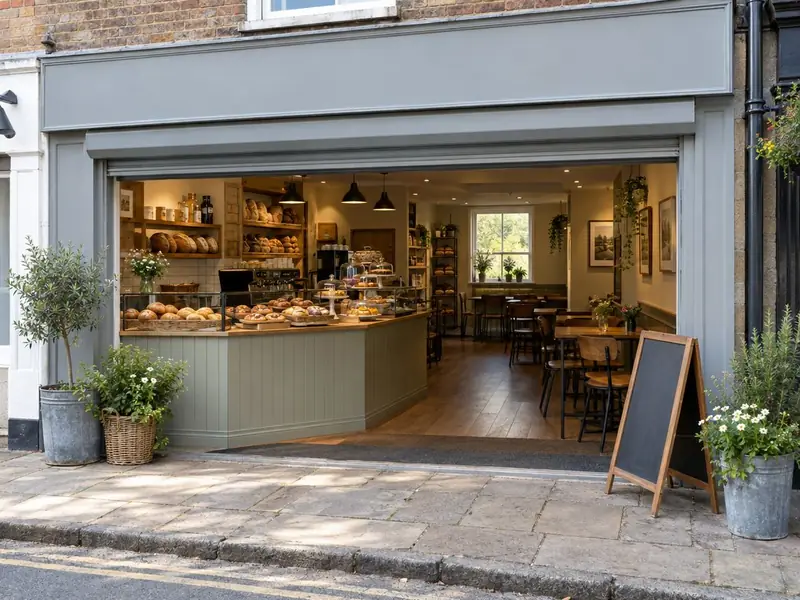
What cafés, coffee shops & bakeries need from a shutter
- Very early starts, with one person opening up in the dark
- Walk-up serving hatches and kiosk counters
- Coffee machines, ovens and tills that are costly to replace
- Outdoor tables and chairs stored near the shutter line
- Steam, flour dust and condensation inside the shop
What do cafés and bakeries need from a shutter?
Bakeries and coffee shops often start work long before customers arrive, sometimes before dawn, so the person opening up is usually alone and in the dark. A shutter that is heavy or awkward makes that harder. Equipment is the main thing to protect: espresso machines, ovens, display chillers and tills are expensive, and a break-in can stop trading while they are repaired or replaced.
Many cafés also have a walk-up hatch or kiosk window, outdoor tables and chairs, and a frontage whose appearance matters because the welcome is part of the offer.
Inside, steam from coffee machines and ovens can raise humidity, and flour dust in bakeries settles everywhere, including on guide rails and bottom rails. Both affect how a shutter runs over time, which is worth bearing in mind when choosing materials and planning maintenance.
How do I secure a serving hatch or kiosk?
A counter shutter is a compact roller shutter for hatches, kiosk windows and serving counters. It can be fitted independently of the main shutter, so you can open the hatch for early takeaway trade before the seating area opens, or close it while the inside is still being cleaned down. As a guide, counter shutters cost £695–£1,495 ex VAT supplied and fitted.
For standalone kiosks where the shutter forms most of the enclosure, an insulated aluminium shutter can help with temperature and condensation.
Which main shutter suits a café frontage?
An electric shutter with a manual override is the practical choice for early opening, operated by a key switch or remote. A perforated or internal shutter keeps the café looking inviting after hours and tends to sit better with council shopfront guidance than solid steel.
A few practical points help a café shutter run smoothly:
- Keep a clear space under the shutter line, so stacked furniture or A-boards never stop the curtain closing fully.
- Keep the bottom rail and guides free of crumbs, flour and grit.
- Make sure everyone who opens up knows where the manual override is.
Outdoor furniture is a common source of shutter damage. Tables and chairs stacked against the frontage overnight can catch the bottom rail as it comes down, bending laths or tripping the safety edge on an electric shutter. Agreeing a fixed spot for furniture, clear of the shutter line, avoids most of these problems.
What does a café shutter cost?
Guide prices for a typical shopfront of about 3 m × 2.5 m, supplied and fitted, ex VAT: electric solid £1,495–£2,695; perforated electric £1,695–£2,895; internal £1,395–£2,595; insulated aluminium £1,795–£3,195. Prices are confirmed as a fixed written quote after a free survey, and VAT at 20% is added. See how much shop shutters cost for what affects the figure.
External shutters generally need planning permission, and many cafés sit in busy town centres or conservation areas where councils publish shopfront design guides. Perforated or internal shutters, with the box hidden behind the fascia, usually stand the best chance. Check with your local planning authority before ordering.
What we usually recommend
| Electric shop shutters | Opening before dawn is simpler with a key switch or remote than with a manual shutter. |
|---|---|
| Counter & serving hatch shutters | A counter shutter secures a takeaway hatch or kiosk window independently of the main shutter. |
| Perforated shop shutters | A perforated curtain keeps the café looking welcoming and lit after closing. |
| Insulated aluminium shop shutters | Foam-filled aluminium laths help with temperature and condensation where the shutter forms most of a kiosk's enclosure. |
Questions shop owners ask
Can we open the hatch while the main shutter stays down?
Yes, if the hatch has its own counter shutter. Because a counter shutter works independently of the main frontage shutter, you can open the hatch for early takeaway trade while the rest of the café stays closed, or close it while staff clean down inside. Counter shutters can be manual or electric, depending on size and how often they are used.
What happens if there is a power cut when we need to open?
Most electric shutters have a manual override, such as a crank handle or a hand chain, so the shutter can be raised without power. A battery backup unit is another option, letting the motor run for a limited number of cycles during a power cut. Make sure every member of staff who opens up knows where the override is and how to use it.
Do insulated shutters help with condensation?
They can. An uninsulated steel curtain gets cold overnight, and warm, moist air left from coffee machines, ovens and dishwashers can condense on its inner face. Insulated aluminium laths, which are foam-filled, reduce how cold that face gets, and good ventilation helps too. As a guide, insulated aluminium shutters cost £1,795–£3,195 ex VAT for a typical shopfront.