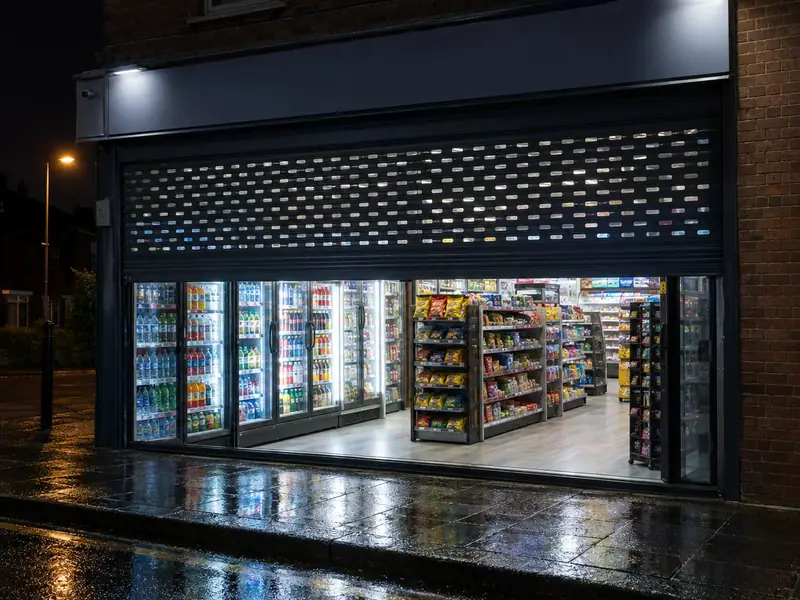
What convenience stores & newsagents need from a shutter
- Long opening hours, often with one person opening up and locking down alone
- Tobacco, vapes, alcohol and scratchcards kept close to the shopfront
- Forced-entry and ram-raid attempts aimed at the door and main window
- Early-morning newspaper and stock drops left at the shopfront before opening
- Twice-daily use that wears manual gearing, springs and locks
What makes a convenience store different to secure?
A corner shop or newsagent is usually open from early morning to late evening, often with one member of staff opening up and locking down. The shutter goes up and down at least twice a day, every day, so ease of use matters as much as strength. A heavy manual shutter that needs a hook pole and a strong arm at six in the morning soon becomes a shutter that gets left half open.
The stock is also the kind thieves look for: tobacco and vapes behind the counter, alcohol, scratchcards, phone top-ups and mobile accessories. These are small, valuable and easy to resell, which is why the door and the main display window are the first points to protect. Side windows facing an alley or car park deserve a look too, because they can be attacked out of sight of the street.
Deliveries add another wrinkle. Newspapers, bread and milk are often left at the shopfront before anyone arrives, so the area in front of the shutter needs to stay clear enough for the curtain to open without obstruction. If you also have a rear stockroom door, it is worth deciding at the outset whether that needs its own shutter.
Which shutter works best for a corner shop?
For most convenience stores we suggest an electric roller shutter with an external key switch or a radio remote, plus a manual override for power cuts. The main choice is the curtain:
- Solid laths give the most privacy and weather protection, but present a blank face to the street at night.
- Perforated laths let light out and allow a view in, so a lit shop still looks occupied.
- Punched laths with polycarbonate vision panels show more of the window display while keeping a solid feel.
If your insurer has asked for a specific security rating, we can supply an LPS 1175 certified shutter and give you the certificate reference. Our guide to perforated vs solid shop shutters covers the trade-offs in more detail.
What does a convenience store shutter cost?
As a guide for a typical shopfront of about 3 m wide by 2.5 m high, supplied and fitted, excluding VAT:
- Manual solid shutter: £895–£1,495
- Electric solid shutter: £1,495–£2,695
- Perforated electric shutter: £1,695–£2,895
- LPS 1175 certified shutter: from £3,495
These are guide ranges. The actual figure depends on size, fixing position, power supply and finish, and is confirmed as a fixed price in writing after a free survey. VAT at 20% is added. If you already have a manual shutter that works but is wearing you out, a manual-to-electric conversion typically costs £595–£1,195 ex VAT.
Will I need planning permission?
External shop shutters generally need planning permission, because they change the look of the shopfront. Many councils prefer perforated, punched or grille-style curtains with the box hidden behind the fascia, and some resist solid external shutters, especially on parades in conservation areas. Check with your local planning authority before ordering; our guide to planning permission for shop shutters explains what to expect. If the shutter will carry your shop name or adverts, advertisement consent may also be needed.
The same rules apply when you replace an old shutter with a different style, so don't assume a like-for-like swap is automatically allowed. Allow for the council's decision time when planning your installation date.
What we usually recommend
| Electric shop shutters | Opening and closing twice a day, often single-handed, is easier with a motor and a key switch or remote. |
|---|---|
| Perforated shop shutters | A perforated curtain keeps a lit shop visible at night, and councils often prefer it to solid steel. |
| LPS 1175 high-security shutters | Where tobacco and alcohol stock attracts determined attacks, an LPS 1175 certified product can be specified. |
| Shutter servicing & safety checks | Daily cycling wears motors, springs and guides, so a regular service helps catch problems early. |
Questions shop owners ask
Should a corner shop have an electric or manual shutter?
If the shutter is opened and closed every day, usually by one person, an electric shutter is generally the more practical choice. It removes the lifting and winding, and a key switch or radio remote means staff do not have to wrestle with the curtain. A manual override lets you operate it in a power cut. Manual shutters still suit smaller openings and tighter budgets.
Do I need to cover the side window as well as the shopfront?
It depends on how exposed the side window is. A side or rear window facing an alley or service yard can be easier to attack unseen than the main frontage. As a guide, a window shutter costs £495–£995 per opening ex VAT, and a retractable grille behind the glass is another option. We look at every opening during the free survey.
Will a shutter satisfy my insurer?
Insurers set their own conditions, so check your policy wording or ask your broker what they expect for the premises. Some simply require a shutter to be fitted and locked; others name a security rating such as an LPS 1175 grade. Where a rating is required, we supply products certified to that level and provide the certificate reference so you can pass it to your insurer.