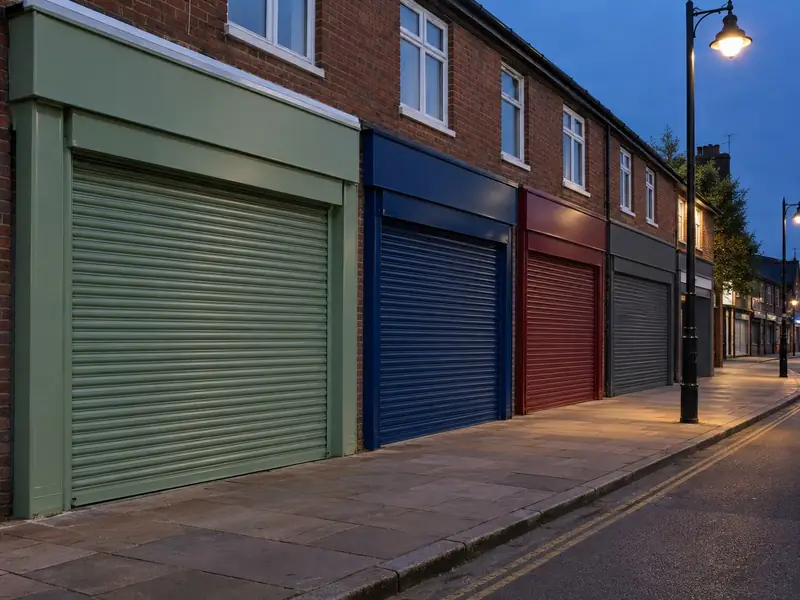
What landlords, agents & shopping parades need from a shutter
- Vacant units between lettings that attract break-ins and vandalism
- Mismatched shutters across a parade that look neglected and complicate planning
- Unclear responsibility for shutter repairs between landlord and tenant
- Powered shutters on several units, each needing regular safety checks
- Flats above shops, where access, residents and planning conditions affect the work
What do landlords need to think about with shop shutters?
Landlords and managing agents look at shutters across a portfolio rather than a single shop. Typical concerns are keeping vacant units secure between lettings, presenting a parade that looks cared for to prospective tenants, and being clear about who is responsible for repairs and servicing. Check each lease: some make the tenant responsible for the shutter, while others keep it with the landlord, particularly where shutters were installed as part of the building or a parade-wide scheme.
When one quote covers several units, it should list each shutter separately so costs can be allocated to the right lease or service charge. Our written quotes set out each item and the payment terms, and the fixed price is confirmed before any work starts.
Why does consistency across a parade matter?
A row of shops with different shutter styles, colours and box positions can look tired and may count against future planning applications. Agreeing one specification, such as a perforated or punched-lath curtain in a single RAL colour with boxes concealed behind the fascia, gives a coherent frontage. Councils' shopfront design guides often favour this approach, and pre-application advice can help before you commit across several units. Our guide to planning permission for shop shutters explains the process.
Where existing shutters are past economic repair, replacement shutters can be phased in unit by unit to the agreed specification, for example as each lease ends.
How should shutter servicing be managed across several units?
Powered shutters should meet BS EN 13241, the product standard, and BS EN 12453, which covers safety in use. Annual servicing is the commonly recommended interval rather than a fixed legal one. For landlords, the practical aim is a clear record: which shutters exist, who maintains each one, and when each was last checked.
- A service visit starts from £125 per shutter ex VAT.
- Repairs are quoted separately, with a diagnostic visit from £125 and typical repairs £145–£495 ex VAT.
- A service log for each shutter helps show that checks have been made.
See roller shutter safety and servicing law for background.
What about empty units and flats above shops?
Vacant units are vulnerable, and a solid shutter on an empty shop can attract graffiti. A perforated curtain with a light left on inside, or an anti-graffiti coating, can help a vacant unit look less abandoned. Where shops sit below flats, plan access for the installation, keep residents' entrances clear of shutter guides and boxes, and check any planning conditions on the building. External shutters generally need planning permission, and conservation areas and listed buildings bring further consent requirements.
Before re-letting a unit, have its shutter checked. A shutter that sticks, runs noisily or will not lock can put off a prospective tenant and may need attention before handover. Converting an old manual shutter to electric, typically £595–£1,195 ex VAT, can also make a unit more attractive to let. Handing the incoming tenant the shutter's service log and keys or remotes, along with clear operating instructions, helps avoid early faults and disputes.
What we usually recommend
| Shutter servicing & safety checks | Planned servicing across several units keeps safety checks and service logs in one place. |
|---|---|
| Replacement shop shutters | Replacing worn or mismatched shutters to one specification gives the parade a consistent look. |
| Perforated shop shutters | Perforated curtains are often favoured by councils and help a parade look active after hours. |
| Shop shutter repairs | Damaged or worn shutters can be diagnosed and repaired before they hold up a new letting. |
Questions shop owners ask
Who is responsible for a shop shutter, the landlord or the tenant?
It depends on the lease. Some leases make the tenant responsible for repairing and servicing the shutter, while others keep it with the landlord, especially where shutters form part of the building or a parade-wide scheme. Check the repairing covenants and any schedule of condition, and agree who keeps the service records so responsibility is clear.
Should every shop on a parade have the same shutter?
Not necessarily identical, but a consistent specification usually helps. Matching the curtain type, colour and box position gives the parade a coherent look, can support planning applications, and makes servicing and spare parts simpler. Units with different needs, such as a jeweller whose insurer wants a certified rating, can still follow the same colour and box arrangement.
Are landlords legally required to service shop shutters?
There is no single fixed legal interval for servicing shop shutters, but powered shutters should be kept in safe working order, and annual servicing is commonly recommended. Whoever controls the shutter under the lease should be able to show it has been maintained. A service log recording each visit, fault and repair is the simplest way to evidence that.