What jewellers & watch shops need from a shutter
- Very high-value, easily carried stock in window displays
- Insurance conditions that may specify a security rating for the shutter
- Smash-and-grab and ram-raid attempts on display windows
- Out-of-hours attacks using hand and power tools
- Balancing display visibility with keeping stock out of reach
What do insurers usually ask of a jeweller's shutter?
For jewellers and watch retailers, the shutter specification often starts with the insurance policy. Insurers set their own conditions, and for high-value stock these may name a minimum security rating, such as an LPS 1175 grade, and sometimes the type of shutter or how it is locked. Ask your insurer or broker for the requirement in writing before you get quotes, so every quote is for the same standard.
LPS 1175 certification belongs to a manufacturer's tested product and is listed in the LPCB Red Book. We are not certified ourselves: we supply certified high-security shutters and give you the certificate reference, which you can pass to your insurer. See LPS 1175 ratings explained for how the grades work.
Policies may also cover how the shutter is locked, whether it must be lowered whenever the shop is unattended, and how stock is handled overnight. Many jewellers clear their windows into a safe at closing time regardless of the shutter, and some policies require it. A shutter is one layer of protection; your alarm, safe and procedures sit alongside it.
How do I keep my window display visible?
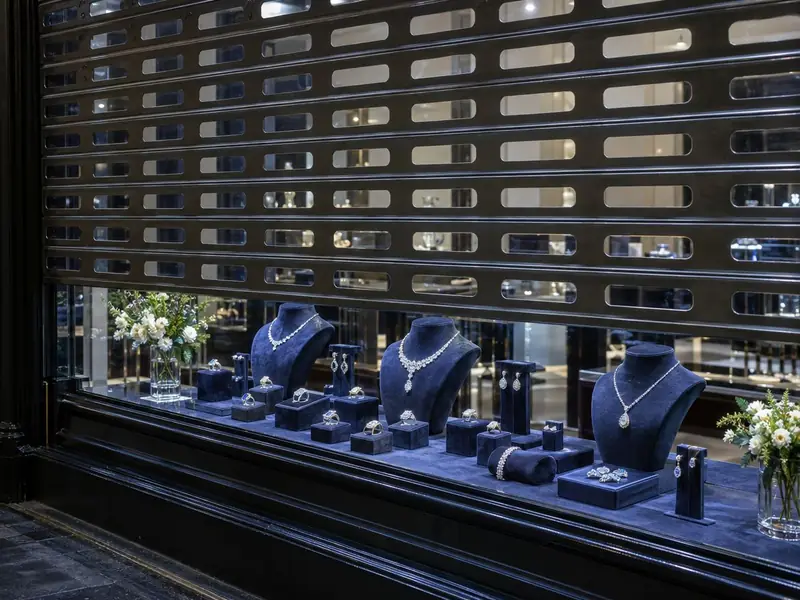
- Punched laths with polycarbonate vision panels show the window while keeping a robust curtain.
- Perforated laths give a partial view through small holes and let light out.
- Solid laths give the most cover where displays are cleared into a safe every night.
Certified ratings apply to the exact product as tested, so not every curtain style is available at every rating. Check which combinations are certified before settling on a look, and confirm with your insurer that the chosen product meets their requirement.
Lighting makes a difference too. A lit window behind a vision shutter keeps the shop looking cared for after hours, while the most valuable pieces can be moved to the safe and replaced with lower-value display stock.
What about planning for a high-security shutter?
External shutters generally need planning permission, and jewellers are often on prime high streets or in conservation areas where councils publish shopfront design guides. Solid external shutters can be resisted, while vision or perforated curtains with the box concealed behind the fascia are more likely to be acceptable. An internal shutter behind the glass usually avoids planning permission, though listed buildings need listed building consent, and an internal shutter leaves the glass itself exposed. Our guide to shop shutters in conservation areas covers this in more detail.
What does a jeweller's shutter cost?
As a guide, for a typical shopfront of around 3 m × 2.5 m, supplied and fitted, ex VAT: LPS 1175 certified shutters start from £3,495; punched lath and vision shutters are £2,195–£3,695; concealed fascia shutters are £1,995–£3,495. The certified rating, size, operation and finish all affect the final figure, which is confirmed as a fixed price in writing after a free survey. VAT at 20% is added.
Because high-security curtains are heavier than standard ones, most jewellers choose electric operation with a key switch or secure remote, plus a manual override. Annual servicing, from £125 per shutter ex VAT, keeps the shutter working as intended and gives you a maintenance record if your insurer asks.
What we usually recommend
| LPS 1175 high-security shutters | Where an insurer specifies a security rating, an LPS 1175 certified product lets you show exactly what has been fitted. |
|---|---|
| Vision (punched lath) shutters | Punched laths with polycarbonate vision panels keep the window display visible while the curtain stays strong. |
| Electric shop shutters | Heavier high-security curtains are far easier to operate with a motor and a secure key switch or remote. |
| Shutter servicing & safety checks | Regular servicing keeps a high-security shutter working properly and builds a record your insurer may ask for. |
Questions shop owners ask
Can you tell my insurer which rating the shutter has?
Yes. LPS 1175 certification belongs to the manufacturer's tested product, and certified products are listed in the LPCB Red Book. When we supply a certified shutter we give you the product's certificate reference and rating, which you can pass to your insurer or broker. We are not certified ourselves, so the certificate comes from the manufacturer's listing.
My insurer mentions SR ratings. Is that the same as LPS 1175?
SR ratings, such as SR1 or SR2, come from Issue 7 of LPS 1175. Issue 8 uses a letter and a number instead, such as B3 or C5, describing the category of tools used in testing and the delay achieved. The two systems are not a direct one-to-one match, so ask your insurer which ratings they accept and we can quote a product certified accordingly.
Should a jeweller's shutter be electric?
High-security curtains are heavier than standard ones, so an electric operator is usually the practical choice. A key switch or secure remote controls the shutter, and a manual override allows operation in a power cut; battery backup is also available. Discuss how the controls fit your opening and locking routine, and any insurer conditions, at survey.